A customer holds up a phone instead of a license on November 18. Decide what your Connecticut counter does
On November 18, Connecticut residents can carry their driver's license in a free state app. Businesses don't have to accept it, and looking at the screen isn't enough if they do. Before someone shows one at your counter, decide what staff say and what you'd buy to check it.
Connecticut Mobile ID launches November 18, 2026. Businesses aren't required to accept it, and those that do must validate it with a compatible verification app, not by looking at the phone. Law enforcement won't accept it in place of a license, and it can't be used for voting. Write a counter policy before launch day, and wait for the Department of Consumer Protection's guidance before buying a verification solution.
The scene
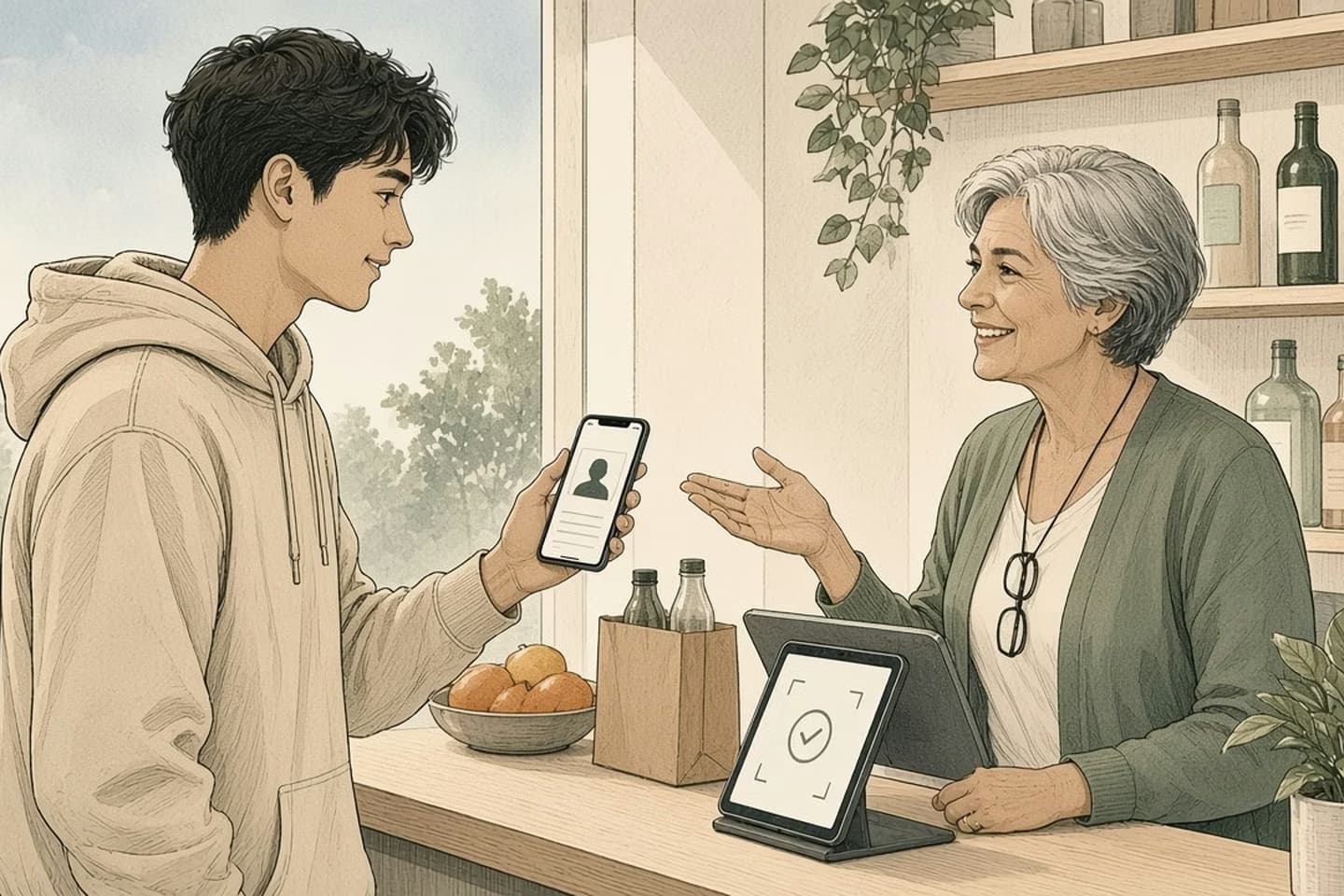
It's a Saturday afternoon in late November at a package store outside Hartford. A customer in his twenties puts two bottles on the counter. The clerk asks for ID. He holds up his phone, showing his Connecticut license in the state's new app.
The clerk has three possible responses. She can take the phone, look at the photo and birth date, and ring the sale through. She can say "sorry, we need the physical license." Or she can scan the phone with a verification app on the store's tablet and get an answer.
Only two of those are acceptable. Connecticut Mobile ID launches on November 18, and the state's announcement is clear on two points: businesses are not required to accept it, and businesses that do accept it are required to use a compatible verification app to validate it. The DMV also says it can't be used as a "flash pass." A phone held up at the counter isn't an ID check. The check is what your verifier says.
So the first option, the one most clerks will reach for when it's busy, is the one to rule out before launch day.
Decision guide
Three ways to respond at the counter
| Consideration | Acceptable | Not acceptable |
|---|---|---|
| Decline mobile IDs | Ask for the physical card. | Arguing about it at the register. |
| Accept with a verifier | Scan with a compatible app. | Look at the phone screen. |
| Verifier is down | Fall back to the physical card. | Take the phone on trust. |
What the state has said so far
The Connecticut DMV announced the launch date on October 29. The facts that matter at a counter:
It's free and optional for residents. The app is on the App Store and Google Play. Setting it up needs the physical license or ID card, and the state says residents should keep carrying the physical card.
Acceptance starts small. TSA accepts it at participating checkpoints, including Bradley International and Tweed New Haven airports. Law enforcement won't accept it as a substitute for a physical license, and it can't be used for voting. The DMV says acceptance will initially be limited.
Businesses opt in. They can choose to accept mobile IDs "as usage increases," by adopting a Mobile ID verification solution that meets their operational needs.
Guidance is coming. The Department of Consumer Protection, which licenses many of the businesses that check IDs, will send information to licensees in those industries over the next month.
That last point sets the order of work. Decide your policy now. Buy equipment after you've read what DCP sends.
A phone held up at the counter isn't an ID check. The check is what your verifier says.
Decide the counter policy now
Whatever you eventually buy, you need a sentence your staff can say on November 18. Pick one of two.
"We don't accept mobile IDs yet." Perfectly legal, and the right answer for most businesses on day one. The customer should still have the physical card, because the app needs it for setup and the state tells people to keep carrying it. Train staff to say it politely and the same way every time, and post it at the register so it isn't a debate.
"We accept mobile IDs with our verifier." Only if you have the verification app running and staff trained on it by launch. If the verifier is down, the answer falls back to the physical card, never to looking at the phone.
Either way, write down the rule about looking at the screen: never accept a mobile ID by looking at it. That's the mistake to prevent, and it's easy to make when the line is long.
Then rehearse the awkward part. Some customers will be surprised, and a few will insist the state says it's valid. Give staff a short, calm answer: the state lets each business decide, and this store asks for the physical card for now. A manager who backs that answer up the first time it's tested will save a lot of arguments later.
If you run more than one location, or employ seasonal staff, the policy needs to reach all of them before the 18th. A one-page note at each register beats an email nobody reads. Our note on seasonal temps and shared logins has the same lesson about rules that have to survive a busy week.
Sequence of work
Between now and launch
- Oct 29, 2026
DMV announces the Nov 18 launch.
- Now
Write the counter policy and train staff.
- Nov 18, 2026
App launches; TSA accepts it at participating checkpoints.
- Within a month
DCP sends information to licensees; then compare verifiers.
If you'll accept it, what to ask before buying a verifier
The DMV doesn't name approved apps in its announcement, and DCP's guidance is still to come. When you start looking, these are the questions that separate a verifier that works at your counter from one that looks good in a demo.
Does it validate Connecticut Mobile ID specifically? "Supports mobile driver's licenses" isn't the same thing. Ask for Connecticut by name, and ask how they know it works.
What does the clerk see? For an age check, the ideal answer is "over 21: yes or no" plus a photo, not a full license record on a tablet facing the line.
What does it store, and for how long? If it keeps a log, find out what's in it, who can see it, and whether you need it for your own records.
How does it fit the counter? A separate tablet, an app on the point-of-sale system, or a scanner you already own? What happens when the internet drops?
What does it cost, and for how many registers? Per device, per scan, per location: get it in writing.
What does DCP say? Once DCP's information arrives, check each vendor's answers against it. If DCP sets requirements for licensees, they come first.
If you're a town office, a library or another public counter weighing the same choice, the questions are the same, with one more: what does accepting it change for the people behind the counter, and who will support it? That's the kind of service decision our government and public sector team helps agencies work through.
The bigger picture for businesses that check IDs
Mobile IDs will spread. Several states already have them, and Connecticut's officials talk about expanding the list of businesses that accept them. The business question isn't whether to accept mobile IDs forever. It's when, and with what. Waiting a few months for DCP's guidance, for verifier prices to settle and for customers to actually use the app costs very little, since anyone with a mobile ID still has the physical card.
For now, the safe and simple move is a clear policy on day one, a careful read of DCP's guidance when it lands, and a buying decision made calmly rather than at the register. If you'd like help writing the policy, comparing verification options once guidance is out, or fitting a verifier into the system your counter already runs, talk to us.
Related work: Sutton Place.
We build alongside the people doing the work.
Bring us the problem you’re thinking about.