Don't sign an SLA you cannot open.
A percentage on a slide is not coverage. Ask for a recovery they already ran, a real on-call window, a past change notice, and a date to practice an incident with you.
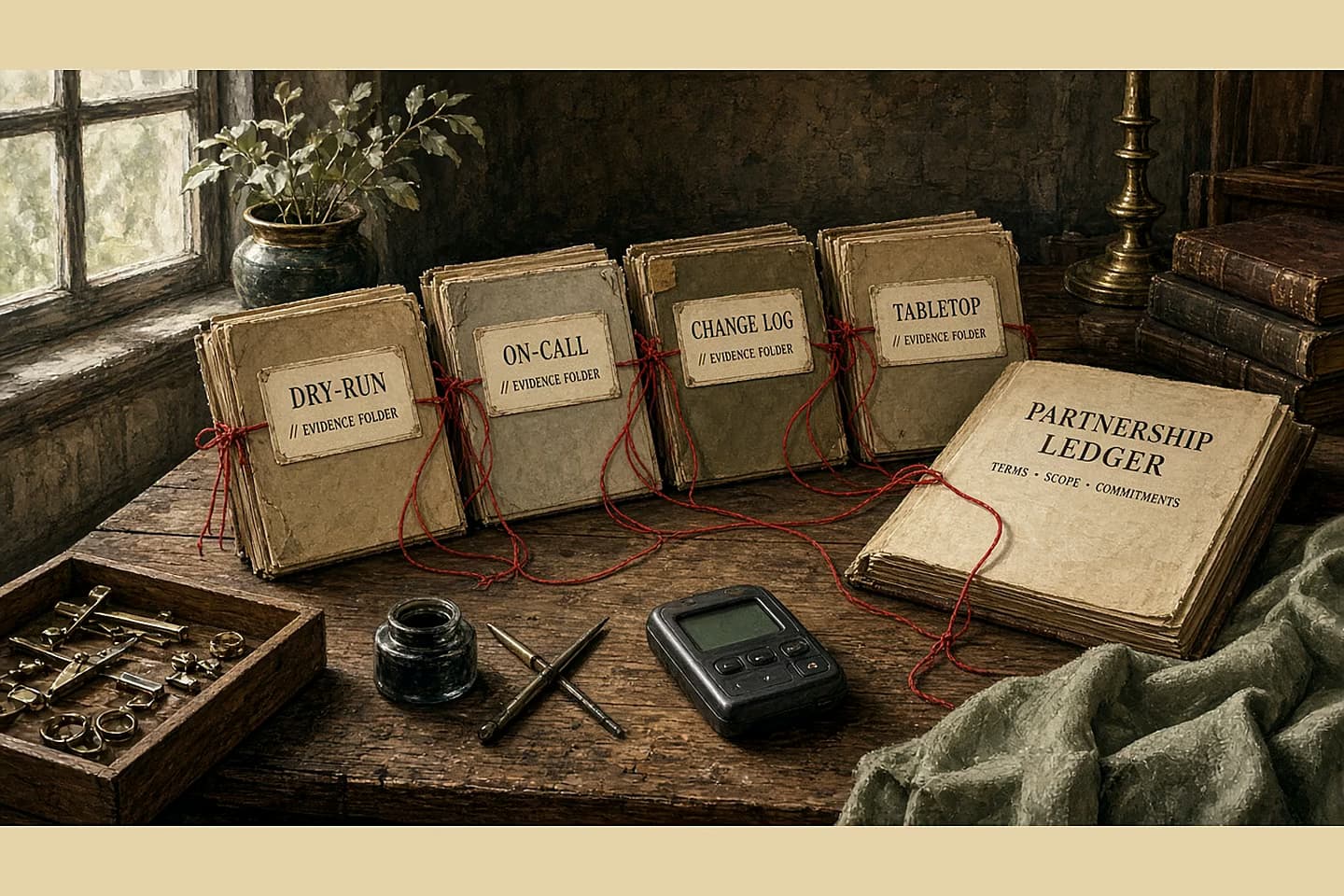
Treat an SLA as coverage only when you can open four things: a dated note from a recovery they already ran, the on-call hours and channel, a real change notice from a past release, and a calendar date to rehearse an incident with your team. If those are missing, you have a promise, not a partnership you can run.
The percentage is not the coverage
You are in a buying meeting. The slide says 99.9% uptime and a four-hour response. Legal starts arguing about the percentage. Nobody asks the question that matters on a Tuesday night: if this breaks, what actually happens, and have they done it before?
That is the note. A service commitment is useful when it points at something you can open. It is decoration when the only artifact is the clause.
You are not trying to out-lawyer the vendor. You want to know whether the partnership has been practiced. Counsel still needs language they can enforce. The people who will get paged need a folder they can read without a translator. Bring both. Do not let one stand in for the other.
Watch the job title they offer you. A customer-success manager is not on call unless the hours and the severity words say so. "We always pick up" is a personality. It is not coverage.
Four things worth asking to see
Ask for four things. If they can show them, then you can talk about the percentage. If they cannot, the percentage is a costume.
A recovery they already ran. Not a promise to test after you sign. A dated note from a restore, a failover, or an escalation they already did. Who was there. What they tried. What stayed broken. Past tense is worth more than enthusiasm.
Who is on call, and when. Hours, channel, and what the severity words mean in their house. A phone number with no window is a voicemail. Ask what happens outside the window, then map their words onto yours. Their severity 2 may be your "orders have stopped."
One real change notice. A redacted example of how they told customers about a production change: when, what it could break, how to undo it. If every sample is cosmetic, ask for one that could have hurt someone. If they cannot find it, assume you will learn about breaking changes from your own errors.
A date to practice with you. A rehearsal on a calendar, with your people invited. "Happy to do one sometime" is how meetings end. A date that slips is coverage getting thinner, even if the uptime number does not move.
If the product holds records you cannot afford to lose, add one more line. When did they last restore data like yours, and who watched? Uptime without a restore is a light left on in an empty room.
How the work moves
Four proofs of partnership coverage
- Dry-run note
Dated practice of recovery or escalation—with failures noted.
- On-call window
Hours, channels, severity, outside-window path.
- Change-log sample
Real redacted sample of how changes were announced.
- Tabletop date
Scheduled joint exercise—not a vague offer.
An SLA without evidence is a brochure with percentages.
How to ask without making it a fight
Put the four asks in the proposal request or the security review, in ordinary language. You are not asking them to build a new department for you. You are asking to see how they already operate.
Name someone on your side to collect the answers. Counsel will not chase a restore note. A platform owner will, if the job is actually theirs. If nobody owns the folder, the folder stays empty and everyone assumes someone else asked.
Ask for the product that can page you, not for the company in general. A promise about the marketing site does not cover the API your orders sit on. If they sell five products, you want the evidence for the one in your path.
If they can only show the material under a non-disclosure agreement, write a cover note the same day. What you saw, the date, and who showed it. You will not remember the call. The cover note is what you will have when renewal comes and the room has changed.
What a thin packet is telling you
Some answers are short and honest. Some are a brochure with extra steps.
A restore note from last quarter that includes the part that failed is real. "We test regularly" is not.
An on-call page with hours, a channel, and a definition of severity is real. A mobile number on a slide is not.
A change notice that says what could break is real. "We will tell you" is a hope you have not tested.
A calendar invite is real. A standing offer with no date is a way to leave the room.
If they will not show any of this, write the refusal down as a buying risk. You may still sign. Do not tell the steering group you saw coverage you did not see.
At renewal, put this year's folder next to last year's. A missing rehearsal, or a narrower on-call window, is a step backward even when the percentage still looks flattering.
Read the slide next to the folder
Do it in one sitting, with someone who would actually get the page.
The slide has a percentage. The folder should have a restore or a failover they already ran.
The slide says support is responsive. The folder should say who, which hours, and what a severity means.
The slide says changes will be communicated. The folder should contain one notice they already sent.
The slide says they would love to run a workshop. The folder should have a date.
Call it a pass when all four are in hand, or scheduled with a person and a date, and someone who was not in the sales meeting can understand the on-call window.
Call it conditional when three are there and the missing one has a date before go-live or before renewal. Put that date where buying and engineering will both trip over it.
Fail it when there is no practiced recovery and no on-call window, or when they cannot show how a change gets announced. That is a license with a slogan. It is not yet a partnership you can operate.
Decision guide
SLA slide vs evidence pack
| Consideration | On the slide | In the evidence pack |
|---|---|---|
| Uptime | A percentage. | Dry-run note of restore or failover. |
| Support | “We’re responsive.” | On-call window and severity model. |
| Changes | “We’ll notify you.” | Change-log sample with blast radius. |
| Readiness | “Happy to workshop.” | Tabletop on the calendar. |
Before you sign
Keep the page with the contract. Not in a private inbox, and not only on the vendor's drive. If they can edit the only copy, you do not have a record. You have their memory.
Use the same test on an engineering partner, not only on a hosted product. After launch, who is on the hook, in which hours, and what have they already practiced with a team like yours? When the thing you are buying is an application someone has to run, the hard part is often what happens after the demo. That work sits under web applications.
You do not need a thicker slide. You need a folder you can open on a bad night.
Related work: Sutton Place.
We build alongside the people doing the work.
Bring us the problem you’re thinking about.