Build the escalation ladder before the agent gets stuck.
Your agent hits a case it shouldn't handle and posts in a channel. Nobody is sure who owns it, and "soon" isn't a wait time. If nobody answers, it either sits forever or takes a fallback nobody approved.
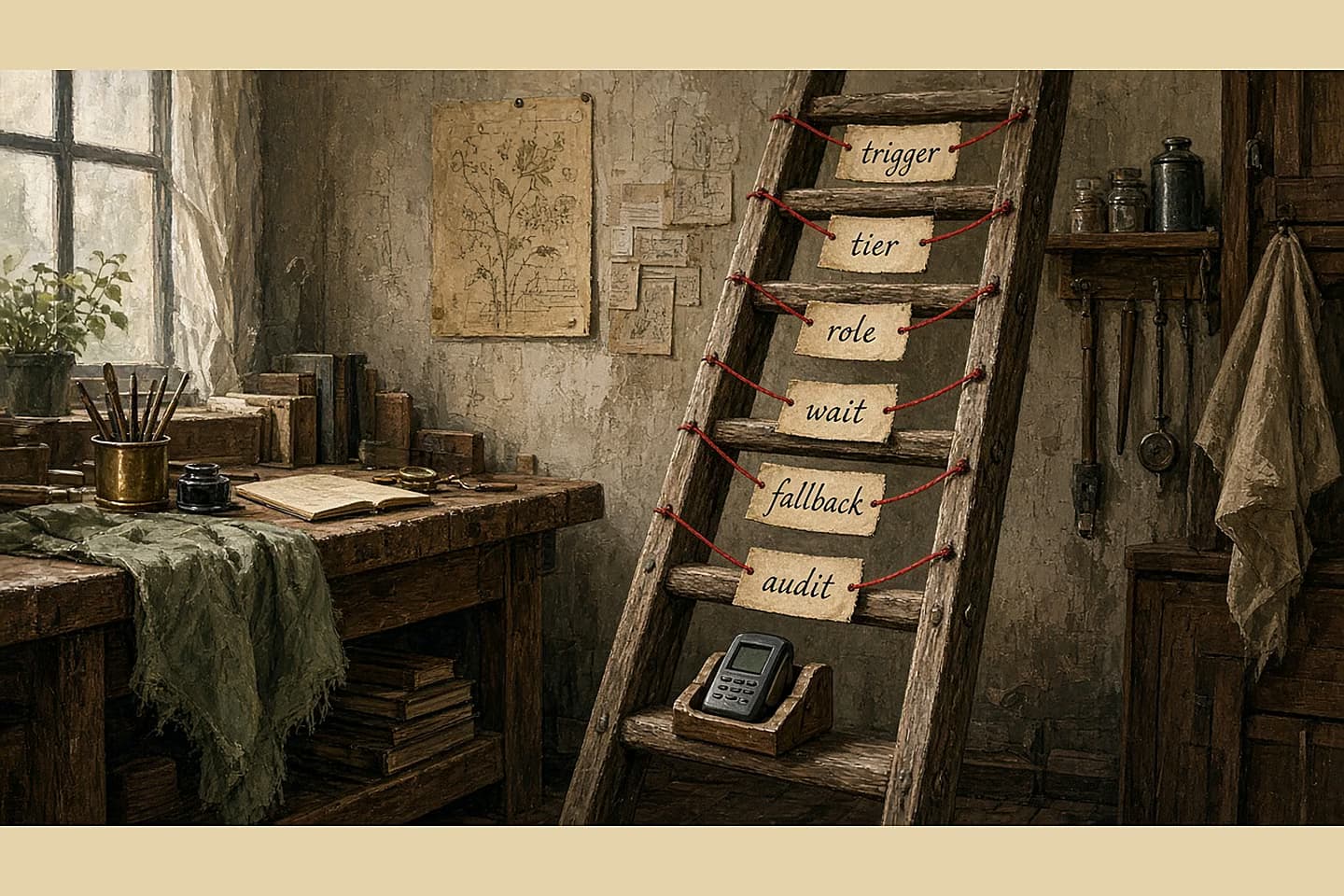
Before an agent operates near real customers or money, fill the TWIMCO Escalation Ladder: for each trigger, define tier, human role, max wait, fallback if the human misses, and audit fields. Escalation that lives only in a Slack @here is not a ladder—it is a hope with notifications.
A channel post is not a plan
The agent hits a line it should not cross, a case it does not understand, or a tool that failed. It posts in a channel. Nobody is sure who owns it. The wait is "soon." If nobody answers, the agent either sits forever or takes a fallback nobody approved.
Escalation is part of the job. Design it before the agent has something expensive in its hands.
One row per way it gets stuck
List the five real triggers. Not a taxonomy of everything an agent might ever feel. The ones you already expect.
For each row: what trips it, who it goes to, how long they have, what happens if they miss it, and what gets written down.
The fallback is the row people skip. Write it anyway. If the fallback is "the agent continues," say that in the room and decide whether you mean it. Timeout is not approval.
Name a person or a role, not @here. Noise without an owner is how cases rot.
How the work moves
One ladder row per trigger
- Trigger
Observable condition that leaves the ordinary agent path.
- Tier + role
Level and named human role—not only a channel.
- Max wait
Clock time before fallback is allowed to fire.
- Fallback
Safe park/notify/disable—never silent continue.
- Audit
Trigger, proposal, decision or timeout, fallback used.
If the agent’s only escalation path is “ping someone,” you designed a bottleneck—not a ladder.
Practice the miss
Walk through one timeout when the human is not sitting there waiting to be heroic. Confirm the fallback, the record it leaves, and who looks in the morning.
Staff the first tier for the hours you claim. A ladder that points at a role nobody covers at night is a diagram.
Review which triggers fire most, and which timeouts hit the fallback. That is how you learn the job is too wide, or the staffing is too thin. It is not a reason to mute the channel.
What goes wrong
The wait is forever, and cases rot. The fallback keeps going, so a miss becomes permission. Nothing is written down, so you cannot tell a noisy trigger from a real one.
If the ladder and the review queue page different people for the same case, pick one home. Two paging schemes confuse the night.
Put this into practice
Fill the rows for the top five triggers. Confirm who is actually on the first tier during the hours you operate. Tabletop one timeout.
The product work around that lives under AI applications and agents.
Related work: Spin Market.
Decision guide
Escalation as noise vs as ladder
| Consideration | Improvised escalation | Ladder row filled |
|---|---|---|
| Who | @here in a busy channel. | Named role on a tier. |
| When | Whenever someone notices. | Max wait with a clock. |
| If missed | Agent keeps trying. | Approved fallback only. |
| After | Thread disappears. | Audit fields in the record. |
We build alongside the people doing the work.
Bring us the problem you’re thinking about.