Write the agent a job spec, not a vibe.
Agent projects still start with adjectives like helpful and on brand. An agent that takes actions needs a job instead, written plainly enough that you could hand it to a new hire on one page.
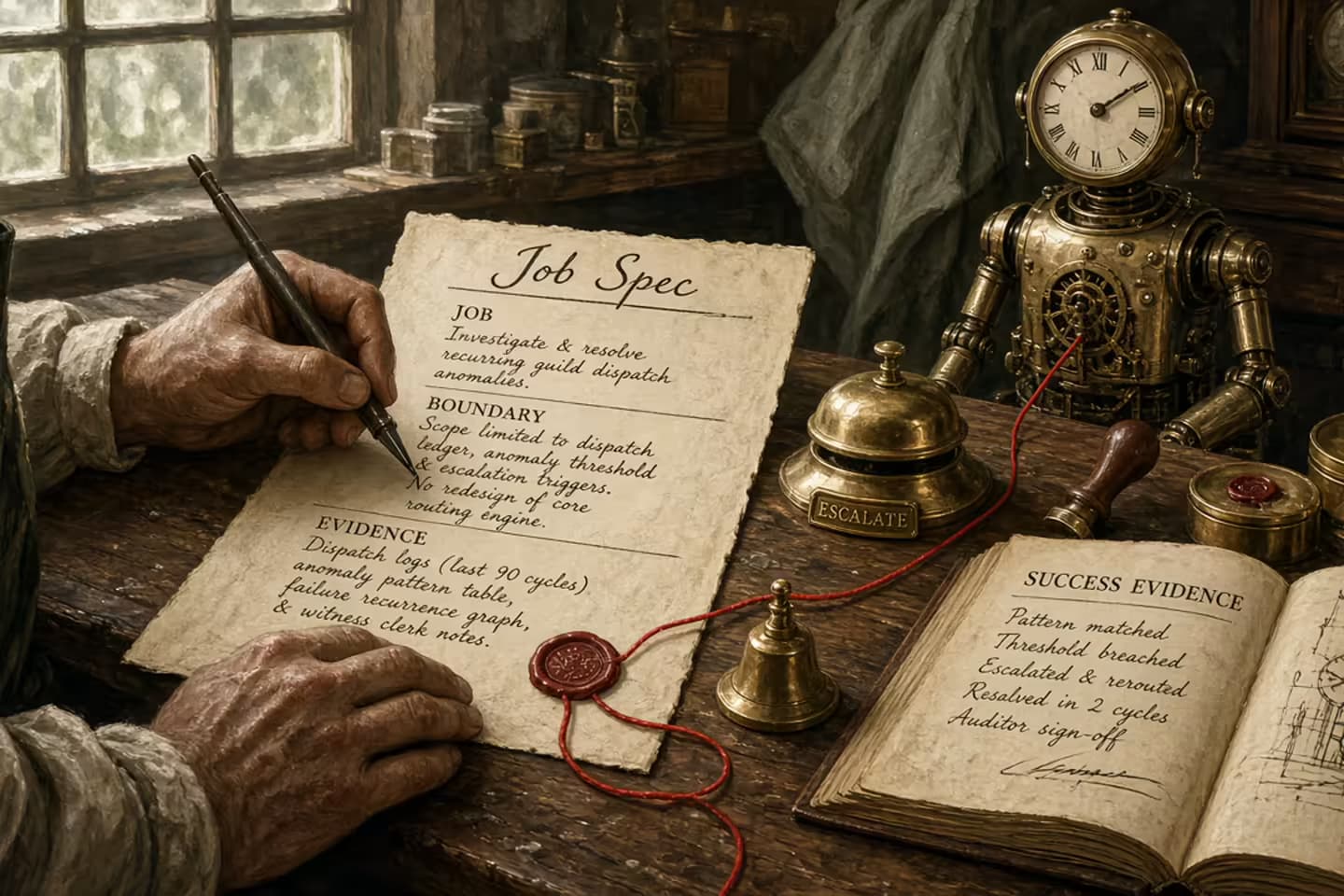
Before you wire an agent, fill a job spec: name the job, bound scope, set allowed modes, define success and failure evidence in the system of record, and name escalation. Share the one-pager. Pair act-level detail with a permission matrix; do not confuse tone with responsibility.
Start with the job, not the tone
Teams still open an agent project with adjectives. Helpful. Witty. On brand. Tone is cosmetics. An agent that acts needs a job: what it is responsible for, what it must never do, what counts as done, and who gets the case when the path is unclear.
Write that down before you wire a tool. A prompt is not a spec. If you cannot hand the job to another person on one page, you are not ready to hand it to a model.
Fill these fields before you connect anything
Copy this into a doc. A blank field is a stop, not a later.
Job name. A verb and an object in the language of the business. "Draft the follow-up for an incomplete seller packet," not "customer success bot."
Outcome. One sentence. The result this job owns when it works.
In scope / out of scope. If out of scope is empty, you have not drawn a boundary.
Allowed modes. What it may read, what it may draft, what it may change. Drafting is not committing.
Success evidence. Where, in the system of record, a stranger can see that the job worked.
Failure evidence. What "stuck" or "wrong" looks like in that same record.
Escalation. Who receives the case, how long they have, and what happens if they miss it.
Audit. What gets written down: who, what changed, and why.
Do not fill this with personality. Fill it with responsibility. The permission matrix, if you have one, comes after: it answers whether a specific action is allowed. This page answers what the job is.
Sequence of work
Fill the job before you wire the tools
- Name the job
Verb + object; one outcome owned.
- Bound the work
In scope, out of scope, required inputs.
- Set the ceiling
Allowed modes: read, suggest, or act.
- Define evidence
Success and failure visible in the system of record.
- Name escalation
Role, audit minimum, review date.
If success only lives in the chat, you do not have a job—you have a conversation.
How this differs from a permission list
A job spec and a permission matrix get confused because both are tables.
The job spec answers: what is this for, how do we know it worked, who catches the exception.
The matrix answers: may it do this action to this data, and who approves.
A red line answers a third question: which commitments stay with a person no matter how confident the draft looks.
Use them in that order. Name the job. Fill this page. Then decide the actions. Skipping to a witty system message is how an agent starts doing things nobody agreed to.
Decision guide
Job spec vs permission matrix
| Consideration | Job spec answers | Permission matrix answers |
|---|---|---|
| Unit of design | One operating job. | One action row at a time. |
| Primary question | What are we responsible for? | May it read, suggest, or act? |
| Success | Evidence in the system of record. | Approval and audit per action. |
| Stops | Out of scope and escalation owner. | Forbidden or human-gated rows. |
| Audience | Operators, eng, reviewers on one page. | Runtime enforcement designers. |
When the spec is too vague to build
The job name is a department. The outcome lists five teams. Out of scope is blank. Success is "users are happy." Escalation is "post in the channel."
That spec will ship as a demo and fail as an operation. Tighten it until one team can own the outcome and one record can show the result.
If you cannot name the failure, you cannot tell a good week from a quiet incident.
Put this into practice
Pick one candidate path. Not a company-wide assistant. Fill the fields. Mark the blanks in a way people cannot miss. Only then write the prompt and the tool list, and only inside the ceiling you just set.
When you want that enforced in the product, not only filed in a drive, the work sits under AI applications and agents.
Related work: Spin Market.
We build alongside the people doing the work.
Bring us the problem you’re thinking about.