Score AI product images on fidelity, not polish.
The color is slightly off, the material is one you don't sell, and the image still looks finished. Image tools are good at plausible. Catalog work needs pictures that tell the truth about what you'll actually ship, and someone named to say so.
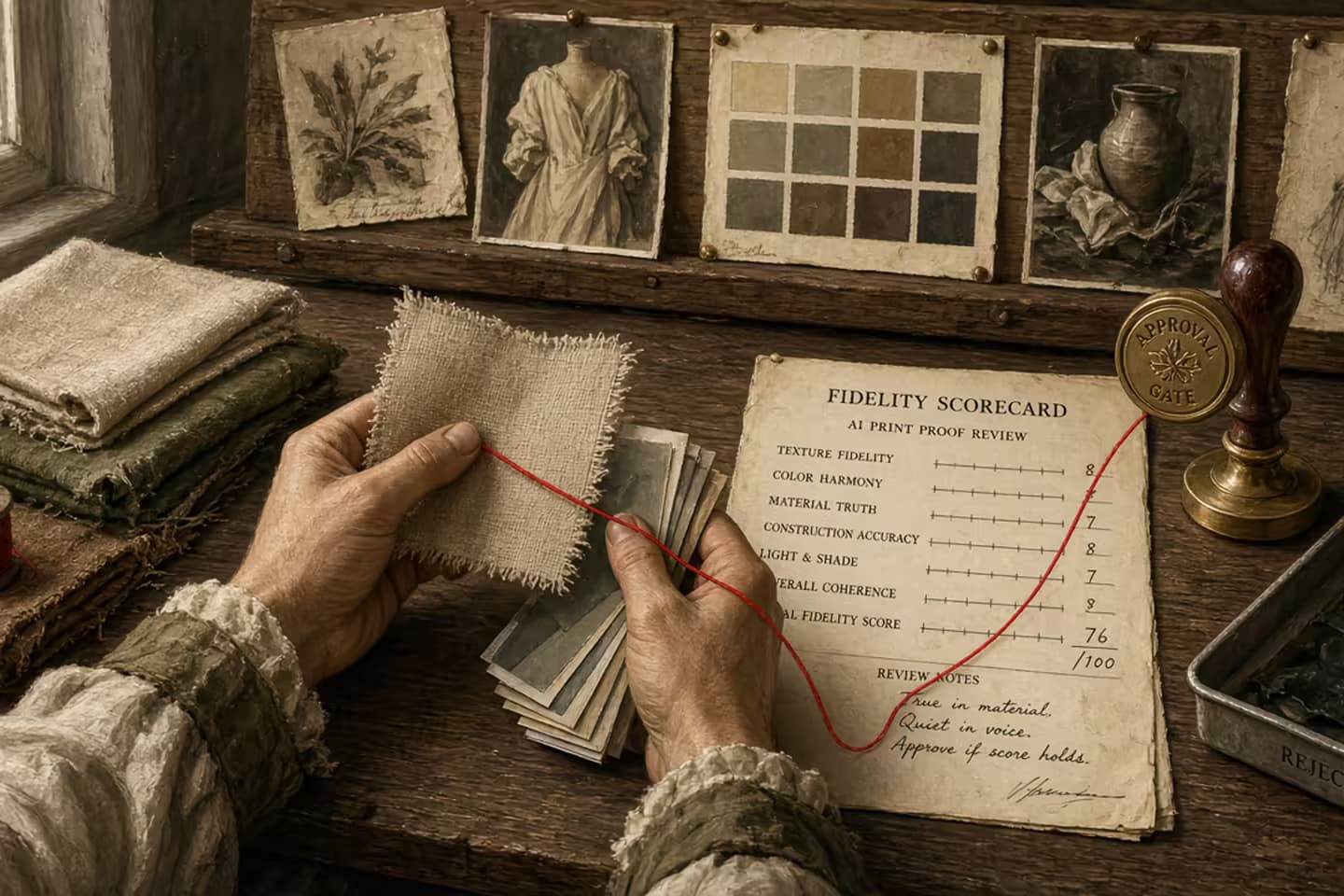
Before you publish AI product imagery, score product truth, intended use, and approval gate 0–2 with evidence against real sources. Require product truth and a named human gate for publish-ready. Polish without truth is not fidelity.
Judge the product before the polish
An image can look finished and still show the wrong product. The wrong color. A material you do not sell. A use the brand would never claim. Image tools are good at plausible. Catalog work needs fidelity: does this picture tell the truth about the thing you will ship, and who is allowed to say so.
Polish is not the argument. A beautiful wrong product is worse than a plain right one, because more people will believe it.
Three scores, with evidence
Score each candidate 0, 1, or 2. Write one line of evidence per score: what you compared it to. A sample photo, a materials note, the product page, a list of claims you are not allowed to make. "Looks fine" is not evidence.
Product truth. Does the image match the sellable thing? 0 means the wrong product, the wrong colorway, or a detail you invented. 1 means mostly right, with one material or finish that is off. 2 means a reviewer can match it to the source without squinting.
Intended use. Does the scene imply a job, a performance, or a lifestyle the product does not have? 0 means a claim you would not put in the copy. 1 means a gray area someone should mark. 2 means the use matches what you are willing to say in words.
Approval. Is there a named person who may publish it? 0 means nobody owns the yes. 1 means a reviewer exists but the reason for a no is not recorded. 2 means a person, a decision, and a reason that the next batch can reuse.
Do not publish on product truth of 0. Do not publish customer-facing images with an approval score of 0. Volume is not a reason to drop the gate.
How the work moves
Three fidelity dimensions before publish
- Product truth
Match the sellable SKU against a named source of truth.
- Intended use
Scene and implications align with approved use language.
- Approval gate
Named human decision with recorded approve or reject.
- Publish rule
Require truth = 2 and gate = 2; reject any zero on truth or use.
A convincing picture of the wrong product is still the wrong product.
How to run a pass
Open the sources first. Then score a small set, not a pile from memory. Score product truth before anyone talks about composition. Aesthetic preference can wait. It is loud, and it is not the risk.
Keep reject reasons specific. "Wrong stitching on the left strap" can become a check. "Doesn't feel premium" cannot.
If early pilots had a human reviewer and the later workflow dropped that person because the volume grew, the rubric's job is to make that drop visible. A gate you removed should be a decision, not an accident.
Where this goes wrong
The wrong product ships because the picture was impressive. A generated scene implies a performance claim that legal would have rejected in a sentence. The approval step disappears the week the backlog gets large.
None of these are model problems first. They are review problems. The model will keep being plausible. Someone has to decide whether plausible is allowed to mean publishable.
Decision guide
Looks good vs fidelity-ready
| Consideration | Looks good | Fidelity-ready |
|---|---|---|
| Product | Plausible and polished. | Matches SKU truth sources; score 2. |
| Use | Attractive lifestyle scene. | Implications allowed by brand language. |
| Decision | Generator ships or thumbs-up in chat. | Named gate with recorded reject reasons. |
| Failure handling | “Make it better” regenerate loop. | Specific truth/use defects feed the next pass. |
| Agents in loop | Model confidence treated as clearance. | Suggest/rank only; publish gate stays human. |
Put this into practice
Pick one product family. Open its sources. Score five images. Apply the rule. Keep the reject reasons specific enough that the next person would make the same call.
If you want help building the review into the workflow, without deleting the human gate, that work sits under AI applications and agents.
Related work: Spin Market.
We build alongside the people doing the work.
Bring us the problem you’re thinking about.