What must live in the record—not in chat.
An approval happens in a channel and a screenshot becomes the proof. Months later nobody can say who decided what, or on which evidence. If closing the tab loses the fact, it was never really recorded.
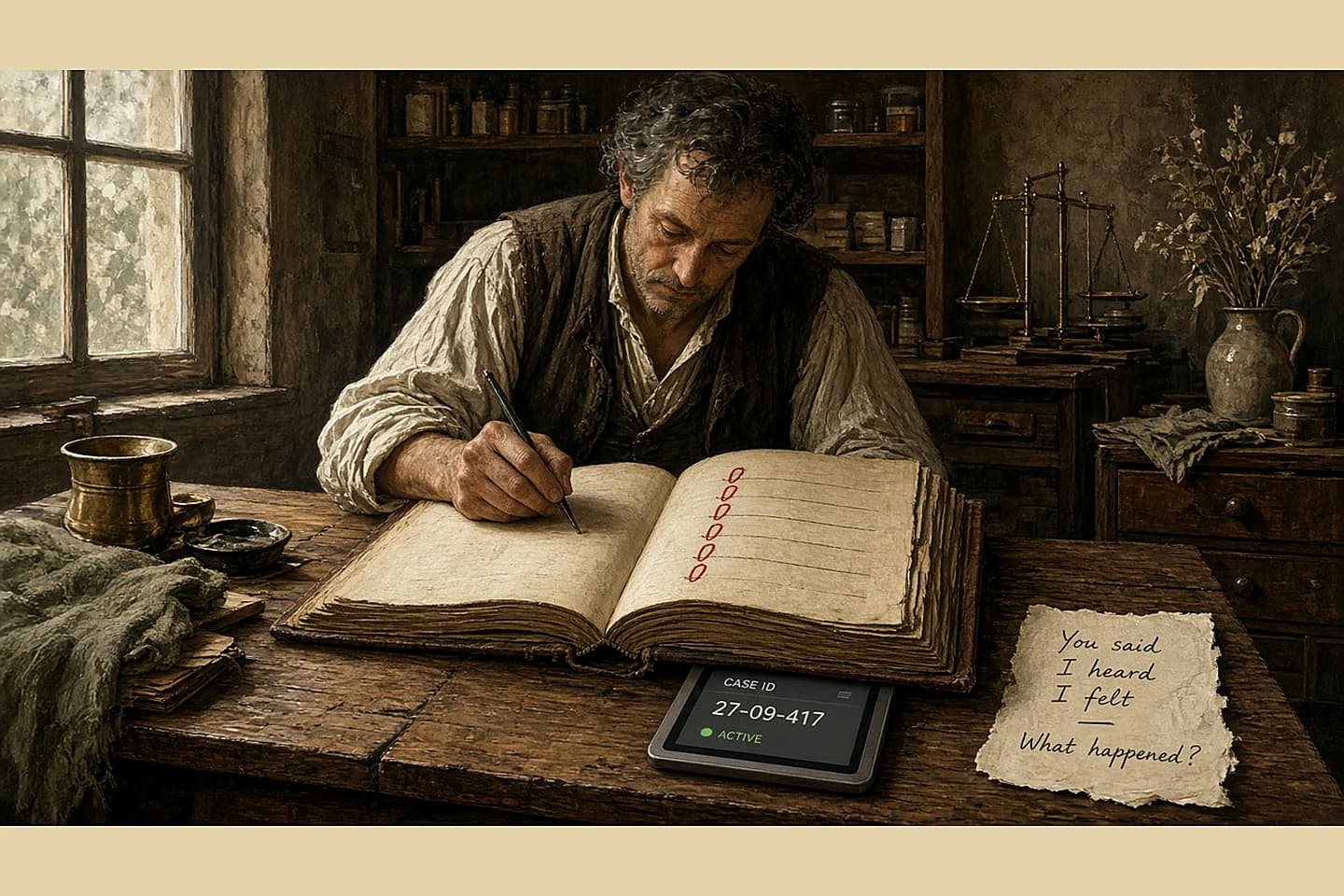
Before you call a workflow “in the system,” run the TWIMCO Shared-Record Completeness Checklist: identity, decision, evidence, owner, and next state must be findable in the system of record without opening a chat thread. Screens and messages may notify; they must not be the only home for those five facts.
Chat is not the system of record
An approval happens in a channel. A screenshot becomes the proof. A dashboard says one thing and the warehouse note says another. Months later nobody can reconstruct who decided what, on which evidence, or what state the case was left in.
Some facts have to live in the shared record, the system the next team will open without you. Chat can notify. A screen can display. If closing the tab loses the fact, it was never recorded.
Five facts a stranger should find
For any workflow that creates or changes a case, ask whether a stranger can find these without searching a thread.
Identity. A stable id for the thing: the order, the claim, the shipment. Aliases linked, not pasted into a message and lost.
Decision. What was decided, in language the record stores. Approve, reject, hold, compensate. Not the tone of a reply.
Evidence. Pointers to what was consulted. Links beat pasted images that rot.
Owner. A role or a person accountable for the current state. A channel is not an owner.
Next state. Where the item sits, and what done or blocked means in the schema. Not a green banner that means three different things.
Chat may say that a decision happened. It must not be the only place the decision, the evidence, the owner, or the next state exist.
How the work moves
Five facts that must live in the record
- Identity
Stable id and linked references in the system of record.
- Decision
Approve, reject, hold, or act—stored as a fact, not as tone.
- Evidence
Pointers to what was consulted; links over rotting screenshots.
- Owner
Role accountable for current state and next action.
- Next state
Where the item sits now, in schema language operators share.
If the decision only exists in a Slack thread, you do not have a shared record—you have a rumor with timestamps.
Run it on one workflow
Pick a workflow where the real decision already happens in chat. Sit with the person who receives the work next. Open the system, not the thread.
Every fact that is missing becomes a ticket against the field or the form that should have captured it. A checklist that stays in a document, with no write path, is advice. Wire it.
This is especially sharp for approvals. The moment is fast. If the product does not capture the five facts then, the team will fall back to chat, because chat is where the conversation already is.
What you will find
A screenshot standing in for a record. A "looks good" in chat while the record still says pending. An owner who is whoever replied last. Two tools that disagree, and nobody who knows which write wins.
These are design problems. They are not a discipline problem you can solve with a reminder to "put it in the ticket" if the ticket cannot hold the fact.
Decision guide
Notify vs record
| Consideration | May stay in chat/screen | Must be in the record |
|---|---|---|
| Ping | “Case 1842 needs review.” | Case 1842 identity, owner, and state fields written. |
| Tone | “Looks good to me.” | Decision value stored with actor and time. |
| Image | Screenshot pasted for convenience. | Evidence link permissioned and durable. |
| Banner | Green status on one dashboard. | Authoritative state other systems can read. |
Put this into practice
Run the five questions on one high-stakes workflow this week, with the people who do the work and the people who build the system in the same room. Add the check to the definition of done for anything that creates a decision.
When the gap is the application itself, that is web applications work: the write path, not another status badge.
Related work: Sutton Place.
We build alongside the people doing the work.
Bring us the problem you’re thinking about.