Everyone at the bench is logged in as Packing 1
Peak brings new faces to the packing bench, and the quickest way to get them started is the old shared login taped to the monitor. It works fine right up until a customer opens the wrong order and nobody can say who packed it.
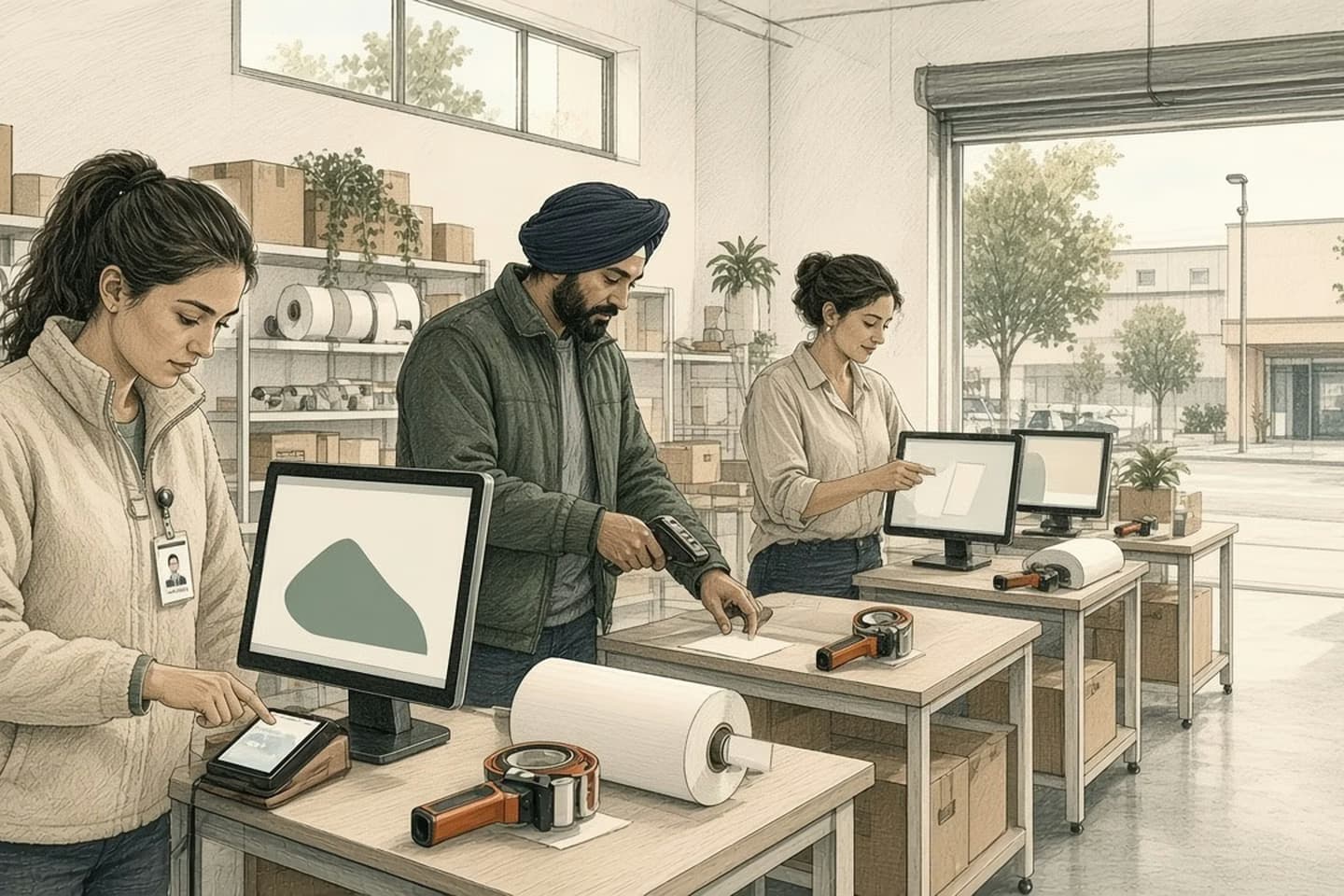
Shared warehouse logins make the first day easy and every question afterward hard: who packed this, who voided that, who needs another hour of training. Give every person their own fast sign-in at the station, such as a badge scan or short PIN, limit what each role can do, set seasonal accounts to expire, and record person and station on every scan. It's about fixing mistakes and coaching people, not blame.
Monday, week two of peak
This is a composite, but anyone who has worked a warehouse in November will recognize it.
It's the second week of peak. Six new seasonal packers started on Friday. The shipping software needs a login, and setting up six accounts would have meant an email to the person who manages the system, who was off. So the supervisor did what supervisors have done forever: logged everyone in as Packing 1, the shared account whose password is on a sticky note on the side of the monitor.
It works. Orders go out. By Monday the bench is moving faster than it did all summer.
On Tuesday a customer emails. She ordered a teal scarf and received a mustard one, with someone else's gift note. Support opens the order. Packed by: Packing 1. Station: unknown, because all four stations use the same account. Time: 2:47 PM Saturday, when eleven people were working.
The question nobody can answer
Was it a new packer who didn't scan the item? A label printed for one order and stuck on the next? A pick from the wrong bin, which means the shelf is wrong and more mistakes are coming? Each of those has a different fix. Without knowing who packed it and where, the supervisor can only send a general reminder to everyone, which helps no one in particular.
A shared login doesn't remove the question of who did it. It just guarantees nobody can answer.
The same fog covers everything else the account can do. Packing 1 voided a label on Sunday and printed a new one. Packing 1 marked an order as shipped that never left the building. Packing 1, as it turns out, also has permission to edit addresses and cancel orders, because years ago someone needed that once and the account was never trimmed back.
Decision guide
Shared login or personal sign-in
| Consideration | Packing 1 for everyone | Personal sign-in at the station |
|---|---|---|
| Day one | Fast: password on the monitor. | Fast if accounts were made in advance. |
| A mis-ship | Eleven possible packers. | One person, one station, one time. |
| Permissions | Whatever the shared account ever needed. | Packers pack; leads void; few cancel. |
| January | Shared password still works. | Seasonal accounts expire on their own. |
A shared login doesn't remove the question of who did it. It just guarantees nobody can answer.
Why the sticky note wins
Nobody chose this because they don't care. They chose it because personal accounts are slow to set up and slow to use.
New accounts need someone with admin rights, and in many small operations that's one person, often not on the floor. Signing in means typing an email and a long password on a shared keyboard with gloves on, many times a day as people rotate stations. Temps come and go, and nobody wants to clean up accounts in January. Against all that, one login taped to the monitor looks perfectly reasonable. In the moment, on a busy Friday with trucks booked, it often is the reasonable call. The trouble is that it never gets undone after the rush.
So the fix has to make the personal way faster than the shared one, not just more correct.
What the bench needs instead
A sign-in that takes two seconds. Badge scan, a short PIN, or scanning a personal barcode on a lanyard. Most packing and warehouse systems can do one of these, or can sit behind something that does. If switching person means typing an email address, people will share.
Accounts made in batches before the season. Create the seasonal accounts the week before the temps arrive, from the staffing agency's list, so day one doesn't depend on someone's inbox. Give them an end date when you create them, so they switch off in January without anyone remembering.
Roles that match the job. A packer scans, packs, prints and reprints. A lead can void and override. Only a few people edit addresses or cancel orders. Trim the old shared account's permissions now, even before you retire it.
Person and station on every scan. The record for each order should say who picked it, who packed it, at which station and when. Not to build a case against anyone, but so the supervisor can see a pattern: one new packer who needs another hour of training, or one station whose scanner misreads.
A floor that knows why. Tell people plainly what's recorded and what it's for. Fixing mistakes and coaching, not surveillance. A team that understands the reason stops seeing the badge scan as a test.
Back to Tuesday
Run the same week with personal sign-ins.
The customer's email comes in. Support opens the order: picked by Dana at 2:31, packed by Luis at Station 3 at 2:47, label printed at 2:47, and a second copy of the same label printed at 2:48, which ended up on the next box. The supervisor walks to Station 3 and finds the label printer set to print two copies, after someone changed a setting on Saturday morning to reprint a jammed label and never changed it back. Ten minutes later it's fixed, and the three other orders packed in that window get checked before they leave.
Luis didn't do anything wrong, as it turns out. He packed the right scarf in the right box. The extra label was waiting in the tray when the next box came down the line, and in a busy hour it looked like the label for that box. Without the record, he'd have been one of eleven suspects, and the printer would still be doubling labels.
That's the point. The record mostly protects the people doing the work. We've written about checking the order against the box at the bench, which catches many of these before they ship; knowing who and where is what makes the rest fixable.
Sequence of work
One order, traced
- 2:31 PM
Picked by a named picker.
- 2:47 PM
Packed at Station 3; label printed.
- 2:48 PM
A second copy of that label prints and lands on the next box.
- Tuesday
Customer reports the wrong item.
- Ten minutes later
Printer setting found and fixed; three orders rechecked.
Put this into practice
This week, walk the floor and count the logins. How many stations, how many people, how many accounts? Look for sticky notes. Then open the shared account's permissions and write down everything it can do that a packer shouldn't.
Before the seasonal staff arrive, ask whoever runs your shipping and warehouse systems one question: can each person sign in at a station in under five seconds? If the answer is no, that's the project.
We build fulfillment operations systems that connect the bench, the warehouse and the storefront, including the small things like how people sign in at a station. If your peak plan still includes a sticky note, talk to us. For accounts that outlive the people who used them, see what happens to access when someone leaves.
Related work: Sutton|Place.
We build alongside the people doing the work.
Bring us the problem you’re thinking about.