Design the exception path on a canvas, not in a hallway.
Payment cleared but inventory didn't. The warehouse can't keep the window the customer was promised. The clean path always gets built first and the awkward cases arrive next sprint as a pile. It goes better the other way around.
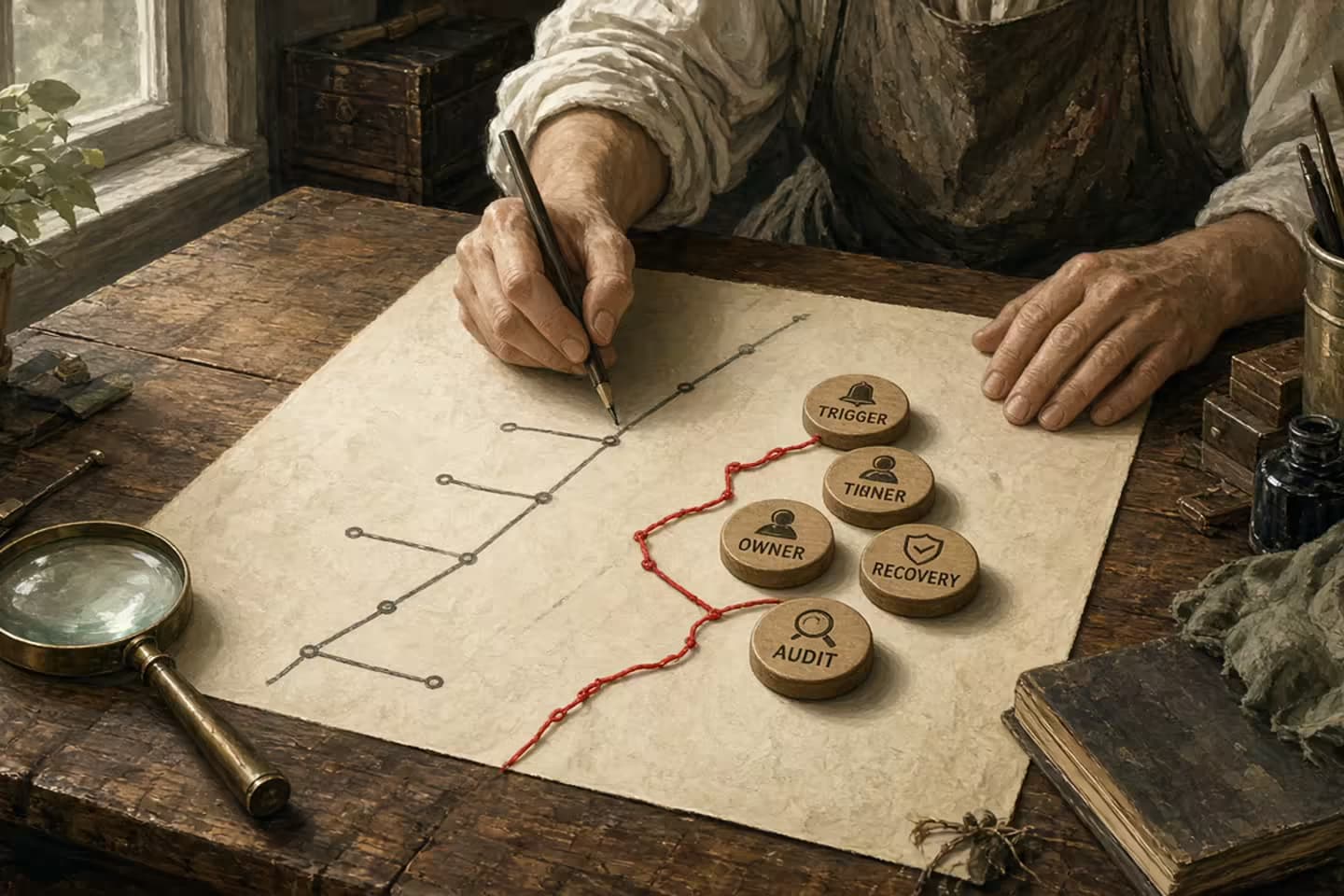
Before you automate the ordinary route, fill a one-page Exception Path Design Canvas: trigger, owner, recovery, and audit for the awkward cases you already handle by judgment. Wire the happy path only after those four cells hold for your most common exceptions.
Design the awkward case first
The whiteboard always starts with the ordinary case. The listing is complete. The payment clears. The shipment leaves on time. The clean path gets built, and the awkward cases are promised a home next sprint.
Next sprint arrives as a pile. Payment succeeded and inventory did not. The customer was promised a window the warehouse cannot keep. A partner call timed out after your side had already written something down.
Name that path before you celebrate the clean one. The clean path is not the hard part. The exception is the work someone already handles with judgment.
Four cells, one page
Keep this next to the process, not in a deck nobody updates.
Trigger. What observable fact means this item cannot take the ordinary route? Missing fields, conflicting statuses, a timeout after a write, a duplicate reference, an external rejection. "Looks wrong" is not a trigger.
Owner. One role that accepts the item. "The team will notice" is not an owner.
Recovery. How it gets back to a known state. Retry after a correction, undo, park with a clock, or continue with an override that has a name and a time. Say which retries are safe and which must be checked first.
Audit. What gets recorded. When it tripped, who had it, what they looked at, what they did, and the state left behind. If that lives only in chat, the page failed.
Fill this for the three awkward cases you already see. If a cell is blank, you are not ready to automate the happy path. You are ready to finish the cell.
How the work moves
Fill the four canvas cells
- Trigger
Name the observable condition that leaves the ordinary route.
- Owner
Assign a role accountable for the next safe action.
- Recovery
Define check-first steps and the return to a known state.
- Audit
Record evidence, actions, and resulting state in the system of record.
If the exception path lives only in a hallway conversation, the automation will invent one under pressure.
Walk one real case into the page
Take last month's mess, not a hypothetical. Sit with the person who fixed it. Ask what they noticed first, what they needed, and what they were allowed to decide.
Write their answers into the four cells. Then ask whether the path still works if they are on leave. If it does not, the owner cell is a person's memory. Fix that before you write workflow code.
A tool that cannot express your trigger, your owner, or your recovery is a buying signal. It will demo the clean path and hand you the inbox.
Wire the clean path after the page holds
Once the awkward cases have a home, the ordinary route is easier to automate without lying. You know where incomplete work goes. You know who sees it. You know what done means on both routes.
Use the same words for both. Waiting, assigned, resolved. People should not learn one language for success and another for trouble.
Do not hide the exception behind a generic "failed." Failure without a next owner is the original problem, with a new status color.
Decision guide
Canvas-ready vs still inventing
| Consideration | Canvas holds | Not ready to automate |
|---|---|---|
| Trigger | Detectable fact or verifiable human check. | Vague sense that something looks wrong. |
| Owner | Named role with standing responsibility. | Whoever is online in the chat. |
| Recovery | Check-first path that avoids duplicate harm. | Blind retry until it seems fixed. |
| Audit | Reconstructable trail in the system of record. | Story reconstructed from memory and DMs. |
Put this into practice
Pick one case type that already goes sideways. Fill the page for its three most common triggers. Walk the recovery with the owner until the first check is boring. Do that before the happy-path ticket gets built.
If you want help turning that page into the workflow, start from business process automation.
Related work: Sutton Place.
We build alongside the people doing the work.
Bring us the problem you’re thinking about.