Map the promise past checkout.
At checkout the customer hears one promise about what's coming and when. Inside the company it's split across inventory, payment, the warehouse, the carrier and support, and when those disagree, the customer is the first to notice.
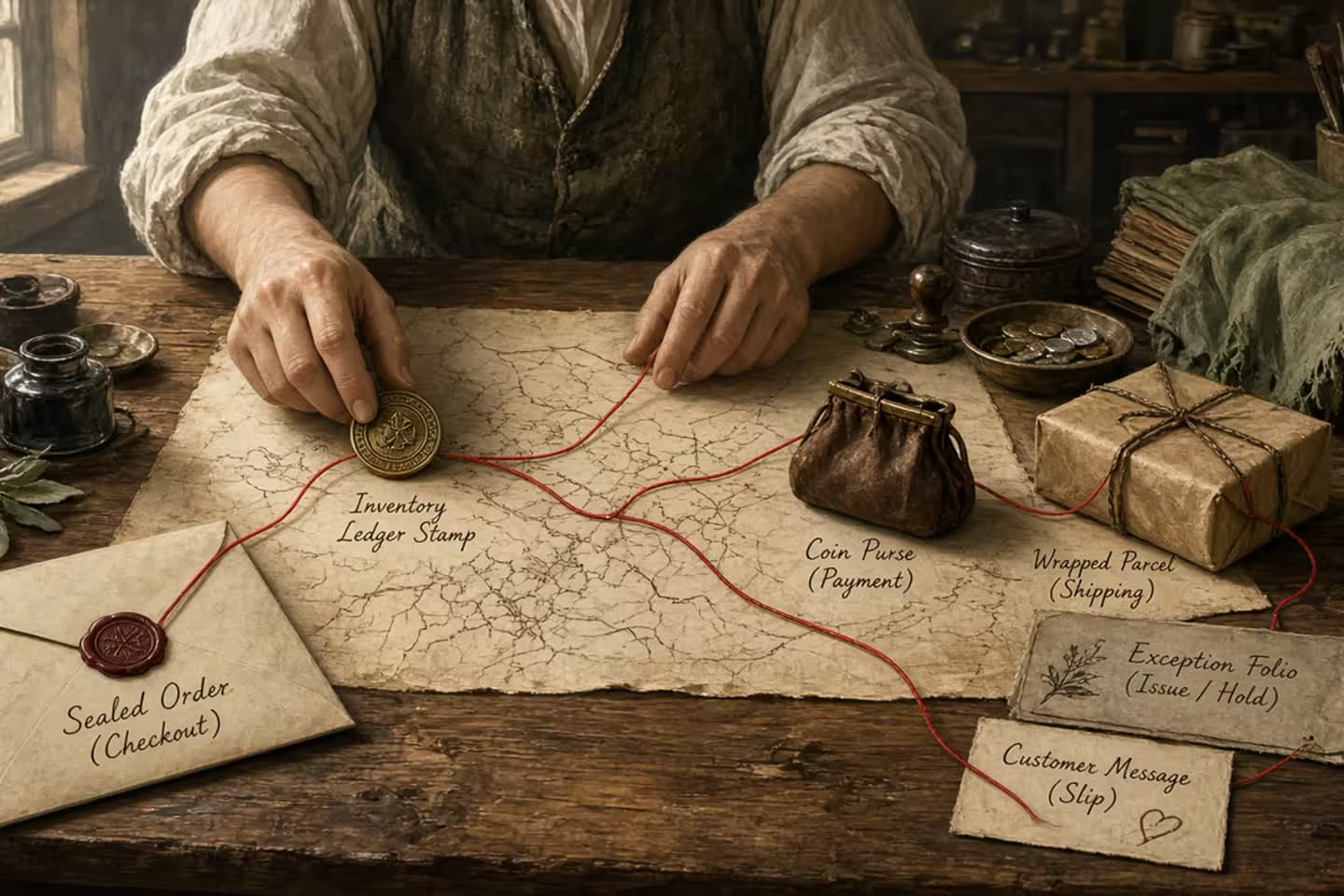
Treat the customer promise as one thread across checkout, inventory, payment, shipping, exception, and customer message. Map each station’s system of record and handoff, then repair continuity breaks before you add storefront features. Checkout starts the promise; continuity keeps it.
The customer is holding one promise
At checkout, the customer experiences one thing: what they bought, when it should arrive, and what happens if it goes wrong. Inside the company that promise is split across inventory, payment, the warehouse, the carrier, and support. When those systems disagree, the customer still has one story. They will notice the break first.
Checkout starts the promise. Continuity is what keeps it.
Six stations
Take one ordinary order. At each station write the fragment of the promise the customer would recognize, the system that is allowed to be right, and who accepts the handoff.
Checkout. What was sold, to whom, under what terms.
Inventory. What was reserved or deducted, and what is still sellable.
Payment. What was authorized, captured, refunded, or held.
Shipping. What left, with which carrier facts, against which promise.
Exception. The case that cannot follow the ordinary route, the owner, and how it returns to a known state.
The message. What the customer is told, from which record, and who may send it.
If a station reads a different "truth" and there is no reconciliation rule, you have a continuity break. It is not a copy problem. Unnamed acceptance is how the promise drifts between stations.
Sequence of work
Trace the promise across six stations
- Checkout
Capture the customer promise: item, terms, identity.
- Inventory
Reserve or deduct with a clear sellable remainder.
- Payment
Align authorization, capture, hold, or refund with inventory truth.
- Shipping
Publish carrier facts that match the promised window.
- Exception → message
Own the break, update stale stations, tell the customer from truth.
The customer holds one promise. Your systems do not get to hold five competing ones.
Find the breaks
Overlay one real order from last month that needed rescuing. Mark every place the customer-facing story and the operational story diverged. A ship promise that survived a stock change it should not have. A payment state the support tool cannot see. A message sent from a cache.
Repair those before you add storefront features. A nicer page will repeat the break to more people.
Exceptions are part of the path
The ordinary order is not the test. The delayed shipment, the partial, the address correction after the label exists: those are where the promise either holds or gets quietly rewritten.
Design the exception into the path. Give it an owner and a message rule. Do not leave it as a tone someone uses in email when the systems have already diverged.
Decision guide
Continuous promise vs fractured ops
| Consideration | Continuous | Fractured |
|---|---|---|
| Source of truth | Each station has an authoritative record and handoff. | Support guesses from screenshots and chat. |
| Exception | Breaks update upstream stations before messaging. | Friendly email while status still says complete. |
| Shipping window | Customer message matches carrier and inventory facts. | Template dates that no station can defend. |
| Refund path | Money and inventory release are reconciled together. | Refund without inventory fix, or the reverse. |
Where this shows up in a marketplace
This is sharpest when the sale is not the end of the experience. TWIMCO built Paddle8's fine-art auction house and marketplace, including the work of carrying a sale into shipping rather than stopping at the bid. The public story is that post-transaction operation. It is not a set of private exception rates, and this note does not invent any.
Use your own orders. The map is the part you can fill on Monday.
Put this into practice
Draw the six stations for one order type. Annotate the system of record and the handoff. Overlay one awkward order. Decide the minimum reconciliation rules before the next storefront feature.
That path is fulfillment and operations.
We build alongside the people doing the work.
Bring us the problem you’re thinking about.