Keep the returns promise continuous across six stations.
Refund on the way, says the email, while the warehouse is still deciding what came back. A partial return gets refunded in full out of habit. The way back needs as much care as checkout, or the promise breaks somewhere in between.
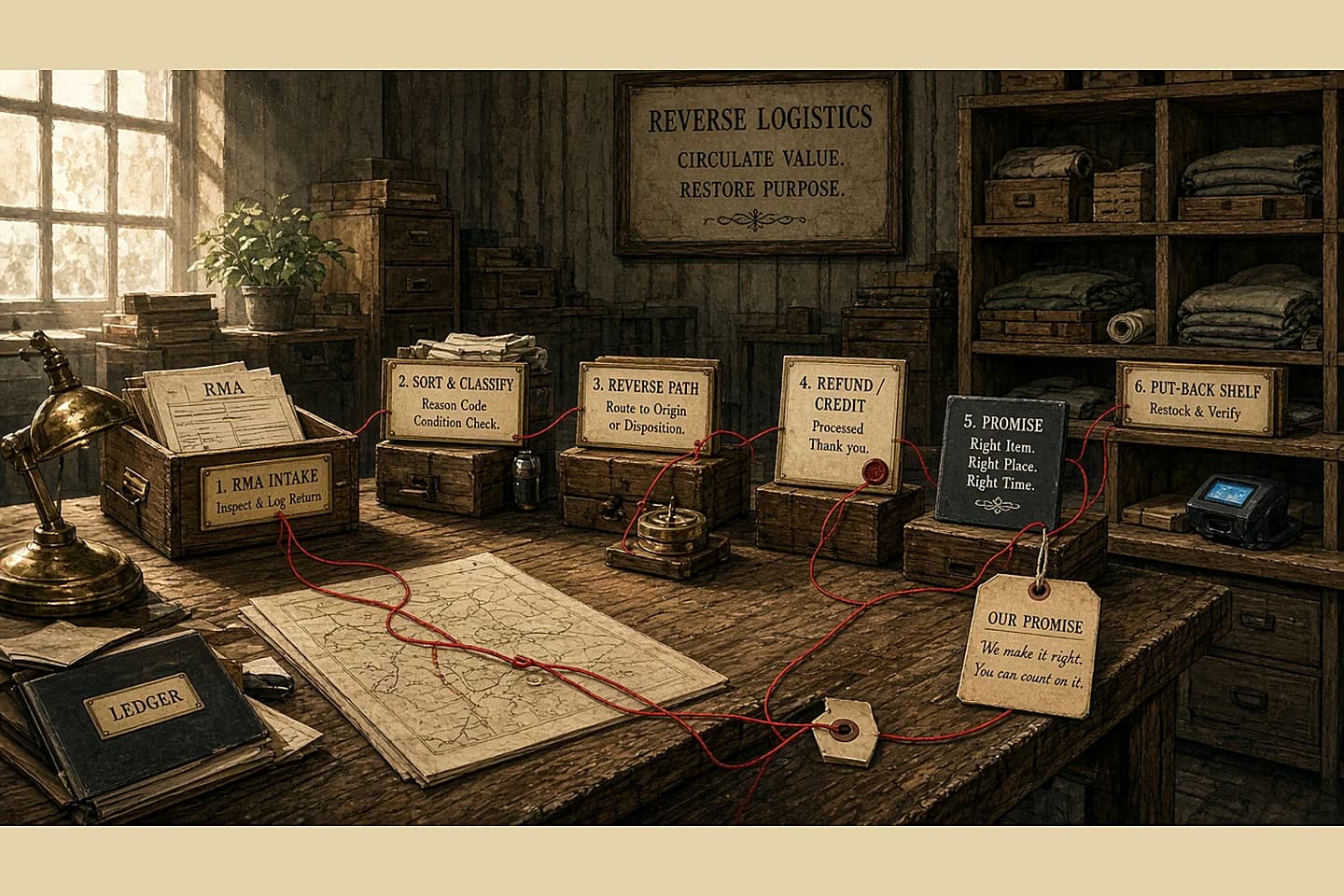
Map reverse logistics as six stations—intake, RMA decision, partials, damage/disposition, refund message, put-back—and require continuity of the customer promise across each handoff. Use the TWIMCO returns continuity map so refund language, inventory truth, and warehouse action do not diverge while the parcel is still in motion.
The promise has to survive the way back
A customer is told a refund is coming. The warehouse has not finished deciding what the goods are. A partial return gets refunded in full because a policy was applied by habit. Damage is found after the unit was put back on the shelf. The return says approved. The carrier says the box never arrived.
Checkout gets the attention. The way back needs the same continuity. The promise you made has to survive each handoff, or you should change the promise before you say it.
Six stations
Draw them for the return type you actually get most.
Intake. The request exists, with the order and what the customer says they are sending.
Decision. Approved, refused, or waiting. A named person or rule, not a mood.
Partials. What happens when some of the goods come back and some do not. Full refund as a default is how partials become expensive.
Damage. Who looks, what they may decide, and whether the unit can be sold again. Put-back before that decision is how damaged stock returns to a customer.
The message. What the customer is told, from which record, and who may send it. A refund email before the goods are in hand is theater.
Put-back. Where the unit goes, and which count changes. If the refund system and the stock system can disagree, write the rule.
Put an owner on each handoff. Unnamed acceptance is how the story splits while the parcel is still moving.
Sequence of work
Six stations on the reverse path
- Intake
Identity linked to order/RMA.
- RMA decision
Approve/deny with evidence in record.
- Partials + damage
Quantity and disposition before inventory moves.
- Refund message
Customer language gated to SoT timing.
- Put-back
Inventory truth follows disposition.
A refund message that races ahead of put-back is a promise the warehouse has not kept yet.
Check five that are still open
Open five live returns. Mark where the customer-facing story and the warehouse story diverge.
You are looking for refund-first messages, full refunds on partial goods, sellable stock with an open damage question, and approvals with no receipt rule.
Fix the split before you add a nicer returns widget. The widget will repeat the split more politely.
What breaks the promise
The message goes out and the stock is never reconciled. Partial quantities are invisible to the refund rule. Disposition happens after the unit is already sellable. The return system and the carrier system are both "right" because nobody wrote which one wins.
These are ordinary. They are also how customers learn to escalate early, because the last return taught them the story would change.
Put this into practice
Draw the six stations for one return type. Add the owner and the promise at each handoff. Spot-check five live returns against the drawing this week.
That operating work is fulfillment and operations.
Related work: Paddle8.
Decision guide
Broken vs continuous promise
| Consideration | Promise jumps | Promise continuous |
|---|---|---|
| Refund | Email before disposition written. | Gate or named advance-refund owner. |
| Partial | Full refund by habit. | Quantity rules in the record. |
| Damage | Found after sellable put-back. | Disposition before availability. |
| RMA | Approved without receipt rule. | Intake evidence required or exception owned. |
We build alongside the people doing the work.
Bring us the problem you’re thinking about.