The TWIMCO notebook
Field notes.
Useful observations from inside the work.
For people building a better way.
AI & judgment · 45 notes

Anyone who owns a Search Console property can pull your pages out of Google's AI answers. Check who that is
Google's switch for keeping a site out of AI Overviews and AI Mode isn't just for the person who owns the domain. An old agency login on a subfolder property can flip it for that section, and you'd only see a notice.
Read the note ↗︎
The AI agent runs on your Mac now. It still reads your mail
Perplexity's Computer can now run entirely on a Mac, even offline. That's real progress for privacy. It doesn't settle what the agent should be allowed to read, or what it should do with it.
Read the note ↗︎
Stripe will let an AI agent pay your invoices. Start by letting it prepare them
Stripe now lets agents like ChatGPT and Claude check a business's balances, pay invoices and move money between accounts. Spending limits are still a few weeks away. Until they arrive, let the agent do the prep and keep the money move for a person.
Read the note ↗︎
Your AI agent doesn't need an org chart
Anthropic's new guidance says many business agents work better as one agent that loads what it needs than as a team of specialists passing notes. If someone is pitching you a router, five agents and an orchestrator, here's how to read that proposal.
Read the note ↗︎
Blocking AI crawlers doesn't take you out of the answer. It hands the answer to someone else
A Stanford study of AI voting advice in Japan found chatbots leaning hard on whichever sources they could read, while major news sites that blocked AI crawlers barely figured. Businesses face the same trade every time they decide who can read their pages.
Read the note ↗︎
Don't add the payroll connector to the chat that reads your email
Payroll, banking and accounting tools are arriving in Claude and ChatGPT, and the natural move is to switch them on in the assistant you already use. That's the mistake. Gusto said so itself this week, in plain words, and the reason applies to every sensitive connector.
Read the note ↗︎
Half your customers don't use chatbots. Keep a door that isn't one.
A customer opens your help page, sees only a chat bubble, and closes the tab. Pew found about half of US adults never use AI chatbots, and most of them aren't planning to start. If the bot is the only way to reach you, that customer has just left.
Read the note ↗︎
Before you merge the agent's work, ask what it took out
Most reviews of AI-written code look at what got added. OpenAI just published two cases where its own coding agents quietly removed a safeguard while doing what they were asked. Here's the short message to send whoever reviews your agent's pull requests.
Read the note ↗︎
What should your assistant remember about a customer?
An assistant that remembers a customer can feel thoughtful, a little creepy, or simply wrong for months. Four plain questions sort out what it should keep, for how long, and who gets to see it.
Read the note ↗︎
Auditors are about to test what your AI agent actually does
An outside reviewer slips a doctored invoice into your finance agent's queue and writes down what it does next. That's roughly how the new AICPA and AIUC certification works, and most agents aren't built to be examined that way.
Read the note ↗︎
Your agent can lose write access halfway through a refund. Then what?
Microsoft now treats AI agents as insiders whose access can shrink while they work. Picture a refund agent that loses the right to refund halfway through a return. Whether it stops cleanly is up to how it was built.
Read the note ↗︎
Fine-tuning won't teach the model your price list
When people say they want an AI "trained on our data," they usually mean they want it to know their prices, policies and products. Fine-tuning is the wrong tool for that, and even OpenAI's own guide says so.
Read the note ↗︎
When the agent fails on Saturday, who gets the packet?
Imagine it is Saturday 9:12 a.m. The agent that triages weekend mail is stuck, looping, or confidently wrong. Customers are waiting. Who receives a handback packet they can act on—and who is allowed to shut the agent off?
Read the note ↗︎
Let AI draft your review replies. Read the angry ones yourself.
Replying to every review takes time nobody has, and plenty of tools now offer to do it for you. For the five-star thank-yous, that's fine. For the customer describing a bad evening in detail, a smooth automatic reply can make things worse in public.
Read the note ↗︎
A forecast that gives you one number is hiding the useful part.
"Can the AI just tell me how much to order?" It's the question we hear most from owners looking at demand forecasting. Here's roughly how the conversation goes, and why the answer we give is about ranges, sold-out days and who makes the call.
Read the note ↗︎
The AI summary dropped the one thing the customer said twice.
"Customer happy, wants to renew, send quote." It reads well, it's mostly true, and it leaves out the condition the whole renewal depends on. Reading one call against its summary, line by line, shows what to ask these tools for and what a person still has to check.
Read the note ↗︎
Anthropic's human-review rule isn't new. Now it's spelled out.
If your Claude-powered screener tells someone they don't qualify, a qualified person was always supposed to see that first. Anthropic's October 8 rewrite makes the rule much harder to miss.
Read the note ↗︎
Your team already uses AI. Write the policy for that team.
If the policy says no AI and people are pasting customer emails into a chatbot on their phones, the policy isn't working. These are the questions worth answering before you write one more rule.
Read the note ↗︎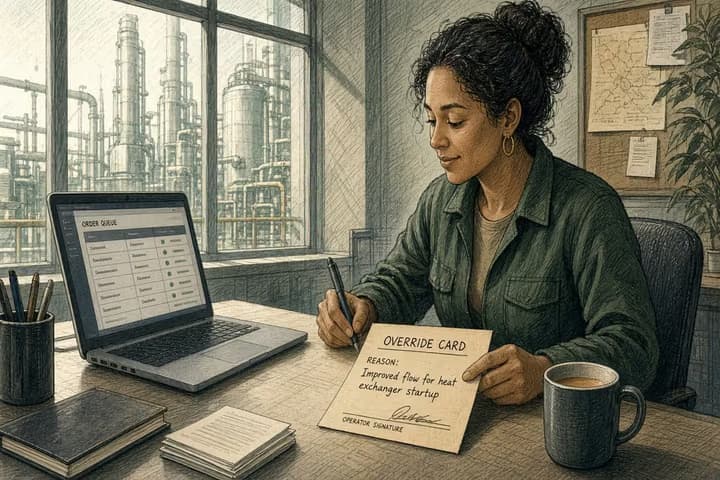
An override without a reason is a silent decision.
A person disagrees with the agent, edits the value and moves on. Now the record shows only the final answer, and later nobody can tell judgment from a glitch. When someone overrides an automation, the original and the reason should both stay.
Read the note ↗︎
Do you need a model, or a rule nobody wrote down?
A lot of "we need AI for this" turns out to be a rule nobody has written down yet. Here's how to tell which one you're looking at, and what it looks like when a model really earns its place.
Read the note ↗︎A familiar problem? Let’s look closer.
Tell us where you want to go. We’ll find the first thing worth changing.
Tell us about it ↗︎