The TWIMCO notebook
Field notes.
Useful observations from inside the work.
For people building a better way.
386 notes

Spec the conflict before the field app ships.
A technician saves a status with no signal. Someone else edits the same record on another device. Both are honest, and when they reconnect one will win, the fields will mix, or the record will freeze. If you don't choose, the software will.
Read the note ↗︎
A macro may not invent a promise.
A customer asks where their order is, and the macro answers in a confident, complete sentence. The warehouse and the payment record never said that sentence. Support copy should repeat promises the system already holds and escalate the rest.
Read the note ↗︎
Other people's agents have already found your public tools.
Wikimedia caught agents trying to turn a citation tool and a public notepad into proxies. Your link previews, URL imports and search box are the same kind of door. Here's how to check them in an afternoon.
Read the note ↗︎
Name the canary before you raise the share.
"We'll start at a small percent" sounds careful. Later you learn the first slice was internal accounts or one region, and you ramped a path you never actually watched. A canary only teaches you something if you named who was in it.
Read the note ↗︎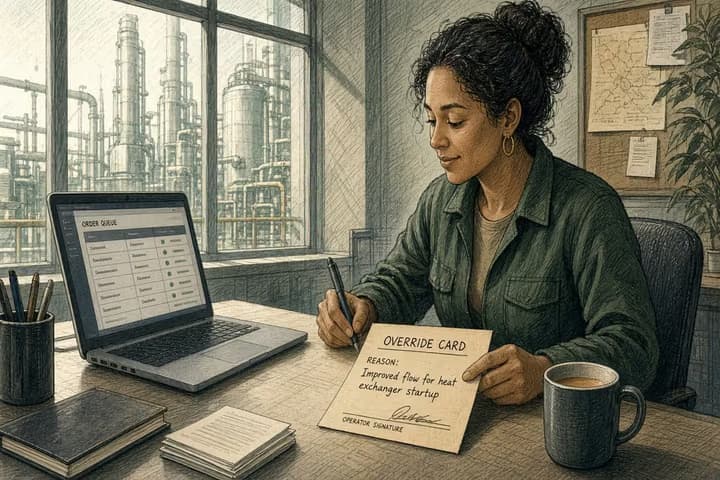
An override without a reason is a silent decision.
A person disagrees with the agent, edits the value and moves on. Now the record shows only the final answer, and later nobody can tell judgment from a glitch. When someone overrides an automation, the original and the reason should both stay.
Read the note ↗︎
Isolation is a checklist, not a logo.
The vendor says multi-tenant and the demo shows two logos in a switcher. Underneath, a column on a shared table may be the only wall, and the support tool can open any account. Check every path that reads or writes, not the switcher.
Read the note ↗︎
Kill the flag, or do not half-kill it.
The flag went in so a path could ship early. Weeks later it's still there, the off state was never designed, and turning it off would strand writes the on state already promised. A flag you can't cleanly kill has become a second product.
Read the note ↗︎
Replay a dead letter, or leave it named.
A webhook fails halfway, and by morning there's a folder of payloads nobody is clearly allowed to resend. Run the handler again and you might charge, notify or advance a deal twice. A failed delivery should stay a record with an owner.
Read the note ↗︎
The route should not live in one person’s head.
Someone on your team knows which carrier will take a crate that size and which lane to avoid this season. Their spreadsheet holds names and rates, but the judgment lives in their head. Sit with them before you build the shipping flow.
Read the note ↗︎
Do you need a model, or a rule nobody wrote down?
A lot of "we need AI for this" turns out to be a rule nobody has written down yet. Here's how to tell which one you're looking at, and what it looks like when a model really earns its place.
Read the note ↗︎
Decide the delete path before you store the record.
A workflow stores a row because it needs a fact on Tuesday. Two years later it's in a warehouse, an export and a ticket attachment, and nobody knows who may remove it or what breaks if they do. Decide how a record ends before you first save it.
Read the note ↗︎
The quote is not the charge until you prove it.
The buyer agreed to a total. Then the payment capture came out different, or the invoice did, or both. Nobody lied. Three systems each told a local truth, and those numbers are worth lining up before the cart is allowed to go out.
Read the note ↗︎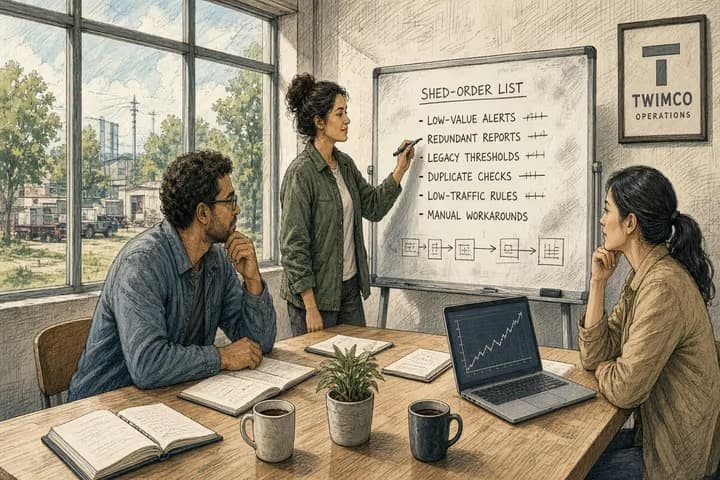
Name what you will shed before the spike.
Auction night, a campaign send, a go-live Monday. You know when the spike comes. Unless it's written down, you don't know which work is allowed to wait, and the spike will drop something you meant to protect.
Read the note ↗︎
Do not promote what you cannot pin.
Since last week's convincing demo, the model alias moved, the prompt was edited in a console and a tool gained a parameter. What you're about to promote isn't what was reviewed. Write down exactly what will run, and stop if any of it drifts.
Read the note ↗︎
A stuck agent needs a packet, not a ping.
When an agent gets stuck, it usually sends a note saying a case needs help. Whoever picks it up reopens the same systems, rebuilds what happened and hopes not to repeat a step that already wrote. The context should travel with the case.
Read the note ↗︎
A dry run only counts if staging matches.
The dry run went well, then production differed in ways the rehearsal couldn't see. A permission the test user had, a flag only on in staging, seed data cleaner than any customer. Check that staging matches before you trust what it taught you.
Read the note ↗︎
Most "where is my application?" calls are a status problem.
If people keep calling to ask where their application is, more phone staff won't fix it. They need to see what state it's in, what happens next, and whether anything is waiting on them.
Read the note ↗︎
Collect the questions before you index the documents.
The person who knows where everything is gets interrupted all day. An internal AI assistant can help, but start with a week of their questions, not a shared drive full of PDFs.
Read the note ↗︎
Before you automate the Friday report, find out who reads it.
Someone exports a file every Friday and spends the morning cleaning it up. Before you automate that, ask who opens it and what they do differently because of it.
Read the note ↗︎
OpenAI's text watermark isn't your record of what AI wrote.
OpenAI's new text watermark is a faint signal that light editing wears away, and you can't check it yourself. Decide the switch per project, then keep your own record.
Read the note ↗︎A familiar problem? Let’s look closer.
Tell us where you want to go. We’ll find the first thing worth changing.
Tell us about it ↗︎