The TWIMCO notebook
Field notes.
Useful observations from inside the work.
For people building a better way.
Product & engineering · 29 notes

Write the change-communication brief before you flip the flag.
Engineering called it a small UX tweak. At 10 a.m. ops finds a status that means something different and a filter that's gone, and support starts inventing explanations. Tell the people who run the system before the flag flips.
Read the note ↗︎
Test the deny shapes before you trust the policy.
Your agent policy says no rm -rf. Has anyone tried TZ="$HOME" rm -rf, a command chained after &&, or a symlink to the file you blocked? Try the odd shapes before you call it enforced.
Read the note ↗︎
Widen write access only after trust is proven.
Read access and open write access are not neighbors. Widen the write only after you can show the last rung actually held.
Read the note ↗︎
Spec “same person” before you sync writes.
Syncing the same person across systems is a write. Decide what counts as a match before that write is allowed to land.
Read the note ↗︎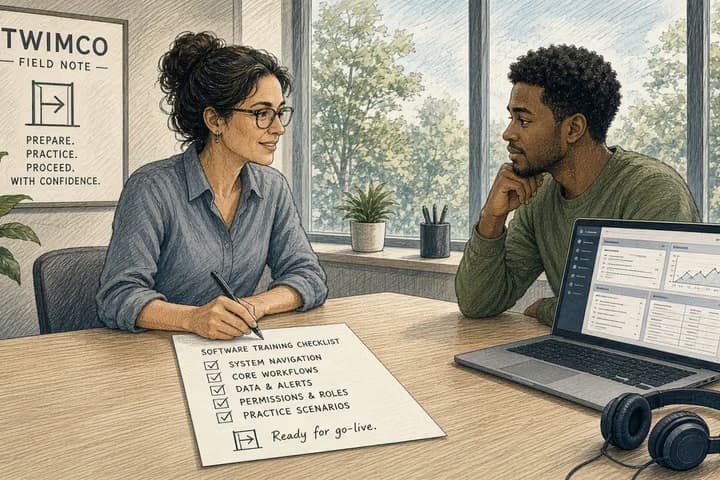
Make training a ship gate, not a slide after launch.
A TWIMCO Operator Training Path Spec: roles, scenarios, pass evidence, and cannot-go-live-until—so the UI is not the whole delivery.
Read the note ↗︎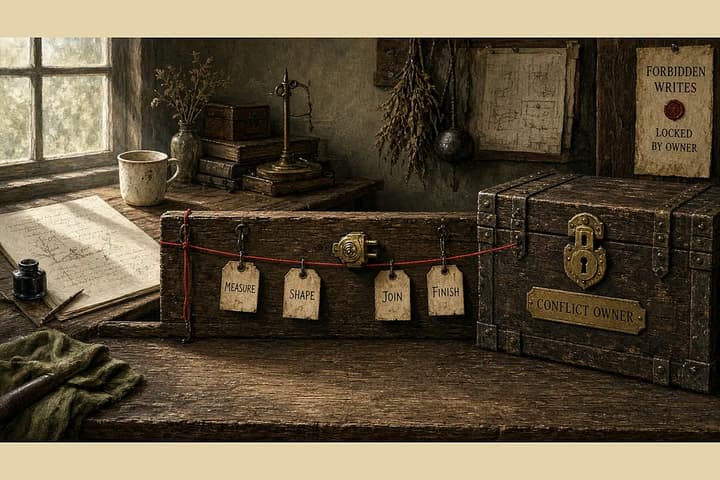
Specify the integration boundary before the first write.
Day one, the happy payload writes fine. Then a retry doubles a side effect, one side updates and the other doesn't, and nobody can say which fields were ever meant to cross. Decide what may and must never be written before the first real write.
Read the note ↗︎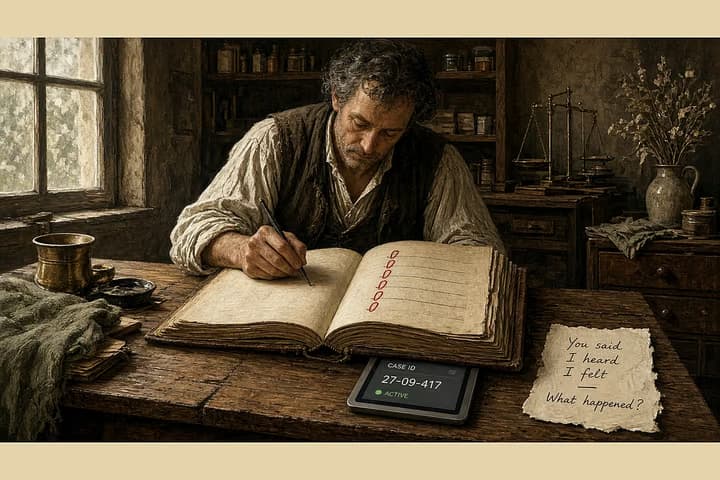
What must live in the record—not in chat.
An approval happens in a channel and a screenshot becomes the proof. Months later nobody can say who decided what, or on which evidence. If closing the tab loses the fact, it was never really recorded.
Read the note ↗︎
Specify visible state, not just a shared screen.
Two people look at the same screen. One thinks the work is done, the other thinks it's waiting on a carrier, and an agent reading it will confidently pick a side. Trust comes from state kept in a record, not implied by a color.
Read the note ↗︎
The work between the screens.
The real requirements often appear when someone shows you how they get through an ordinary day.
Read the note ↗︎A familiar problem? Let’s look closer.
Tell us where you want to go. We’ll find the first thing worth changing.
Tell us about it ↗︎