The TWIMCO notebook
Field notes.
Useful observations from inside the work.
For people building a better way.
385 notes
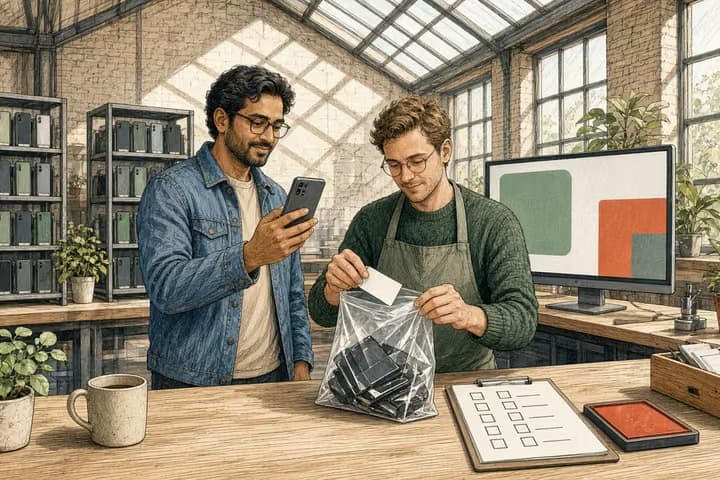
Assume strangers can read what you shipped in the app
Anything baked into a mobile app binary can be unpacked. API keys, hidden URLs, feature flags, and "private" endpoints are not private once the build leaves your machine.
Read the note ↗︎
Get a phone or email on the order before you ship on a balance due
A deposit lands in chat. The handle goes quiet. The parcel is already packed. Marketplace and social sellers who ship against a balance need a durable contact on the order—not only a username.
Read the note ↗︎
Open Shopify's Agentic page before the next AI channel enrolls you
Unless someone on your team has opened Sales channels > Agentic, your Shopify catalog is already being offered to AI shopping assistants, and the next one will be added for you. Here's how to walk that page and decide.
Read the note ↗︎
Can a paying customer get a receipt without cancelling?
Finance asks for a PDF. The customer opens the account page, hunts for Billing, and finds a chatbot that only offers cancel. The receipt was always there—just behind the wrong door.
Read the note ↗︎
If the store stops tonight, what happens to the pre-orders?
On October 12, Zavvi's webstore was replaced by an administrators' notice, and every unshipped pre-order stopped with it. If your store takes money months before the box exists, picture that morning now, while you can still change it.
Read the note ↗︎
Check which checkout option is selected before the customer notices
Somewhere on your checkout or payout screen, one option is already selected. If that default costs the customer more—or you more—the quiet choice is doing work you never wrote down.
Read the note ↗︎
Tab AI review: text it like a person, wait for trust to catch up
Tab emerged from stealth in early October 2026 as a personal AI you text on iMessage or WhatsApp—booking, calling, and paying after you say yes. Who it is for, what the company has disclosed as of October 12, 2026, and what a business owner should still ask.
Read the review ↗︎
Decide what still works when you switch it all off.
When a retailer takes systems offline on purpose to contain a security problem, stores can still ring up sales — if payment, prices, promised orders, and a customer notice were designed to run alone. Write that list tonight.
Read the note ↗︎
OpenAI Dots review: always-on agents with a cloud computer
OpenAI launched Dots on September 29, 2026: always-on ChatGPT agents with their own cloud computer and plugins to thousands of apps. Here is who they are for, what OpenAI says they do, and what a business owner should still decide.
Read the review ↗︎
Your first version should do one job properly. Cut everything else.
Feature lists for a first version tend to be wish lists for year two. Cutting one down is uncomfortable, especially when you're paying for every week of work. Here's what we'd usually take out, and the few things we'd argue to keep.
Read the note ↗︎
Pharmacies check the bottle against the order. Your packing bench can too.
A customer orders the blue one in medium and gets the green one in large. It's a small slip with a long tail of refunds, return labels and reshipping. Pharmacies, where a wrong item matters far more, built their work around a habit worth borrowing.
Read the note ↗︎
Let AI draft your review replies. Read the angry ones yourself.
Replying to every review takes time nobody has, and plenty of tools now offer to do it for you. For the five-star thank-yous, that's fine. For the customer describing a bad evening in detail, a smooth automatic reply can make things worse in public.
Read the note ↗︎
New sellers on your marketplace need a first sale, not a better ranking formula.
Sellers sign up, list a few things, hear nothing for a month and quietly leave. Marketplace founders bring us this question in one form or another, so here's how we'd think about it, starting with what a brand-new listing looks like to a buyer.
Read the note ↗︎
Apple's reviewer gets one try at your app. Make it an easy one.
Somewhere a person at Apple is about to open your app for the first time, with no context and nobody to ask. Apple publishes its own list of the missteps that slow review down or get apps sent back, and very little of it is about code.
Read the note ↗︎
You've inherited a half-built app. Inspect it before anyone quotes a rewrite.
The last developer stopped answering, or the money ran out, or the agency moved on. Now there's an app that sort of works, and the first new developer you call says it should be rebuilt from scratch. That might be right. Find out first.
Read the note ↗︎
AI can write your alt text. It doesn't know which detail the shopper needs.
Listen to your product page with a screen reader and you hear the alt text where the photos would be. An AI tool will fill in those fields in seconds, and most of what it writes will be accurate, tidy and not much help to the person deciding whether to buy.
Read the note ↗︎
A records request passes through five people. Only one of them is the clerk.
Someone asks the city for a set of emails and inspection reports. Behind that one request sit a clerk, a couple of departments, a lawyer, a deadline in law and, very often, a shared inbox holding the whole thing together.
Read the note ↗︎
Plan for the week your payouts stop.
Sales are coming in and the money isn't arriving. Payment providers can hold back funds or pause payouts when an account suddenly looks different, and the stores that cope are the ones that decided what to do before it happened.
Read the note ↗︎
The server you stopped using is still switched on.
Last year's move to new hosting went fine, and nobody has thought about the old box since. It may still be answering the internet and holding keys to the new setup. A breach earlier this month started in exactly that kind of place.
Read the note ↗︎
Deleting a key from your code doesn't delete it.
Somebody pasted a password into the code years ago and took it out the next day. This week a fake "Security Audit" on GitHub went looking for exactly that kind of leftover, and it found plenty.
Read the note ↗︎A familiar problem? Let’s look closer.
Tell us where you want to go. We’ll find the first thing worth changing.
Tell us about it ↗︎