The TWIMCO notebook
Field notes.
Useful observations from inside the work.
For people building a better way.
390 notes

Diff the customer promise against the system before the campaign ships.
Marketing has locked the claim and the creative looks great. Checkout still can't split a shipment, and support has no script for the case the campaign will create. Put each promise beside what the systems can actually do before the spend commits.
Read the note ↗︎
Checklist the disclosure package before the complex close.
A TWIMCO Disclosure Package Checklist: what must be verified, shown, and owned before a complex close—items, evidence, owner, blocker vs note.
Read the note ↗︎
Budget the exceptions before they budget you.
The SLA slide shows on-time rates for the clean cases. Split shipments, payment retries and seller corrections are "handled by the team," and nobody has written down how many of those the team can absorb before something gives.
Read the note ↗︎
Make training a ship gate, not a slide after launch.
A TWIMCO Operator Training Path Spec: roles, scenarios, pass evidence, and cannot-go-live-until—so the UI is not the whole delivery.
Read the note ↗︎
Write rollback criteria before you cut, not after it hurts.
A TWIMCO card for cutover abort and revert: what must stay green, who may call rollback, evidence required, and the restore path per critical system.
Read the note ↗︎
Score exit readiness before you need to leave.
Renewal comes around and switching looks impossible. The export is unclear, identities won't map, and the runbooks live in the vendor's head. The time to find out whether you could leave is while you still have leverage.
Read the note ↗︎
When A succeeds and B fails, decide—don’t improvise.
Payment captures and inventory doesn't. The carrier said yes, but your call timed out. By morning the ledgers disagree, and whoever was awake decided what to retry. Half-done writes are ordinary, so decide in daylight what happens next.
Read the note ↗︎
Specify the human review queue before the agent fills it.
Once an agent starts producing drafts, "we'll review them" turns into a pile with an unspoken deadline and free-text reject reasons. Human review works when you set it up like any other queue you'd staff.
Read the note ↗︎
Smoke the data contract before go-live—not after the first bad write.
Everyone agreed on the payload in a document. Then the first production write used a field the document forgot, and retries started duplicating. An hour of checks against the real edge in staging is cheaper than learning it from customers.
Read the note ↗︎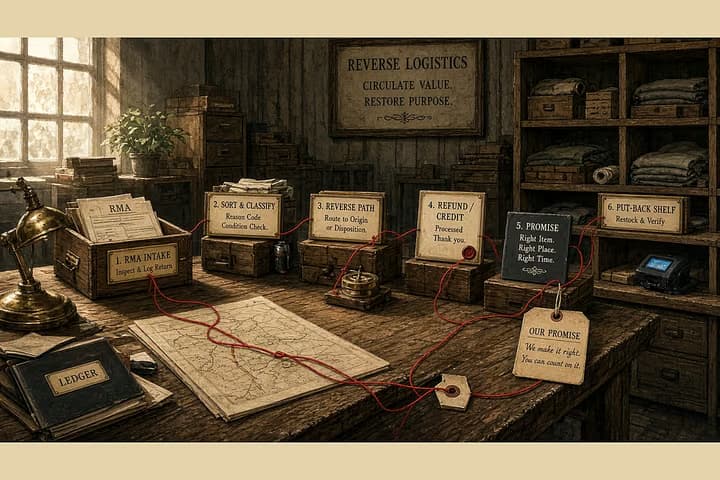
Keep the returns promise continuous across six stations.
Refund on the way, says the email, while the warehouse is still deciding what came back. A partial return gets refunded in full out of habit. The way back needs as much care as checkout, or the promise breaks somewhere in between.
Read the note ↗︎
Map the source of truth before you trust the sync.
Inventory lives in the warehouse system and in a spreadsheet that feeds ads. The customer lives in three tools that merge records differently. Adding another sync job won't settle it. It just copies the argument faster.
Read the note ↗︎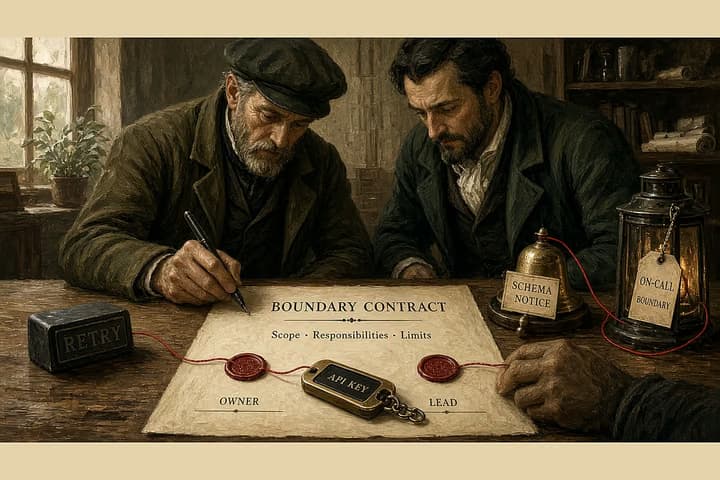
Put a name on every edge that can break the other side.
A retry doubles a charge. A field gets renamed without notice. The ticket bounces between two teams who each point at the connection between them. Every edge that can break the other side needs a named owner on both ends.
Read the note ↗︎
Dual-write cutover needs a checklist—not a brave night.
Turning on dual-write feels safe. Weeks later nobody owns the comparison, rollback is theoretical, and writing everything twice has quietly become the architecture. It only works as a phase with a clear end and someone in charge.
Read the note ↗︎
Build the escalation ladder before the agent gets stuck.
Your agent hits a case it shouldn't handle and posts in a channel. Nobody is sure who owns it, and "soon" isn't a wait time. If nobody answers, it either sits forever or takes a fallback nobody approved.
Read the note ↗︎
Specify the integration boundary before the first write.
Day one, the happy payload writes fine. Then a retry doubles a side effect, one side updates and the other doesn't, and nobody can say which fields were ever meant to cross. Decide what may and must never be written before the first real write.
Read the note ↗︎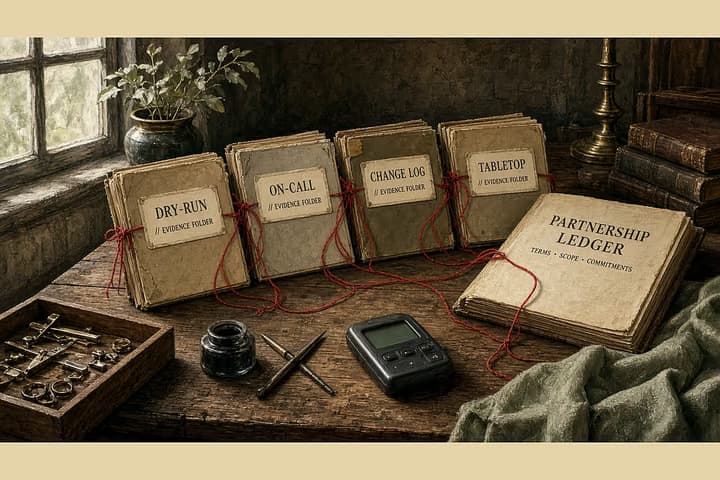
Don't sign an SLA you cannot open.
A percentage on a slide is not coverage. Ask for a recovery they already ran, a real on-call window, a past change notice, and a date to practice an incident with you.
Read the note ↗︎
Write the cutover on one page before the freeze.
The migration plan is a deck, the freeze is "sometime Saturday," and rollback means "we can switch back." Cutovers tend to fail in the blanks nobody filled, and most of those blanks fit on one page if you write them before the freeze.
Read the note ↗︎
Define shadow-mode success before you promote the agent.
Weeks into shadow mode, the agent is still proposing and people are still doing the work. Someone asks if it's time to let it act, and the answer is a shrug. Shadow mode only helps if you decided at the start what would count as ready.
Read the note ↗︎
Score catalog truth before you publish the claim.
Photos, bullets, a price. The page looks finished, but a listed size was never received, the stock number is a cache, and the copy promises a ship speed you no longer keep. Publishing a listing is a promise to fulfill it.
Read the note ↗︎
Treat agent changes like releases—not like prompt doodles.
Someone edits a system prompt on Friday. On Monday the agent does things the team thought were gated, and nobody knows which edit did it or how to put it back. A change to what an agent may do is a release, even when it doesn't look like one.
Read the note ↗︎A familiar problem? Let’s look closer.
Tell us where you want to go. We’ll find the first thing worth changing.
Tell us about it ↗︎